A Porsche PDK failure warning, shown on the dash as “Transmission fault” or “Transmission emergency run”, means the PDK control unit has found a fault in the gearbox, its sensors, its hydraulic control or its power supply. Common causes include low battery voltage, a sensor fault inside the transmission, overheated clutches and a fluid leak, and the fault codes have to be read to know which one you have.
The wording depends on the model and year. Some messages add an instruction, such as a note that reverse may not be available, that you can drive on with care, or that you should park the car safely. Follow the instruction on the screen first.
How PDK works and why it warns you
PDK (Porsche Doppelkupplung) is a dual-clutch transmission. It has two gear sets, one for the odd gears and one for the even gears, each with its own clutch. The next gear is already selected on the other set, and a shift is a handover from one clutch to the other.
A control unit runs all of this through a hydraulic control unit, using sensors that report shaft speeds, the position of the shift mechanisms, pressures and fluid temperature. When a reading is missing or does not match what the control unit asked for, it stores a code and shows a warning. If the fault affects one gear set, the transmission can carry on with the other, which is why some cars lose only the odd or even gears, or reverse.
Common causes of a Porsche PDK transmission fault
| Symptom you notice | What it usually is | What we check |
|---|---|---|
| Warning on a cold start, after weeks parked, or after a jump start | Low 12-volt battery voltage | Battery test, charging voltage, undervoltage codes across modules |
| Some gears or reverse missing, emergency run message | Sensor fault inside the transmission | Codes and live sensor data, wiring and connector at the gearbox |
| Warning after slow traffic, hill holds or repeated launches, sometimes with a temperature message | Overheated clutches or fluid | Fluid and clutch temperature data, fluid level, cooling circuit |
| Harsh engagement, shudder pulling away, no hard fault | Clutch adaptation out of range or aged fluid | Clutch values and adaptation data, fluid service history |
| Fluid spots under the gearbox, delayed engagement | Low fluid from a leak | Pan and gasket, seals, cooler lines, fluid level at the correct temperature |
| Warning with pressure or valve codes | Hydraulic control unit fault | Codes, pressure readings, power and ground, activation tests |
Less common causes include a fault in the selector lever or its wiring, software that needs an update, and internal mechanical wear.
Low battery voltage
Porsches that are driven occasionally are prone to this. The PDK control unit needs stable voltage to work its valves, and a battery that dips during cranking can leave a transmission fault stored along with warnings from other systems. If several unrelated messages arrived together, voltage is one of the first things to test. The same cause is behind many PSM failure warnings.
Sensors inside the transmission
The control unit relies on speed, position and temperature sensors mounted inside the gearbox. When one of them fails or its signal drops out, the control unit can no longer confirm a gear on that gear set and locks it out. This is a well-known source of emergency run messages. How it is repaired depends on the model and on which sensor is involved, so we confirm the fault with data before quoting a repair.
Overheated clutches
A dual-clutch transmission slips its clutches a little every time the car creeps. Long periods of inching forward in traffic, holding the car on a slope with the throttle, or repeated hard launches build heat. The control unit warns and may reduce power or open the clutch until the temperature falls. If it happens in ordinary driving, the fluid level and the cooling circuit need checking.
Clutch adaptation and fluid
The control unit learns the point at which each clutch begins to grip and adjusts as the clutches wear. When the values drift, or the fluid is old, engagement becomes harsh or shudders. A fluid service on the schedule for your model and a clutch adaptation with PIWIS-level tools often restore normal behavior. Neither fixes a hard fault, and we will tell you which you have.
Fluid leaks and the hydraulic control unit
PDK depends on hydraulic pressure to hold its clutches and move its shift mechanisms. A leak at the pan, a seal or a cooler line lowers the level until pressure cannot be held. Faults in the hydraulic control unit itself, such as a valve or pressure sensor, store codes that name the circuit. We test power, ground and pressure before recommending a unit.
Can I keep driving?
Usually fine for a short, gentle drive to a shop:
- The message allows you to drive on, and the car pulls away and shifts cleanly.
- No transmission temperature warning is showing.
- There is no fluid under the car.
Drive smoothly, avoid hard acceleration and plan a route that does not need reverse. If the car is in emergency run, it may not engage a gear again after you switch off, so drive straight to the shop.
Stop somewhere safe and call:
- The message tells you to stop or park the car.
- The car will not engage a gear, or drops into neutral while driving.
- A transmission temperature warning is on. Let it cool with the engine idling in park if the message says so.
- You see fluid under the gearbox or smell burning.
How a shop diagnoses it
At Prestige Auto Repairs & Tires we work through it in this order:
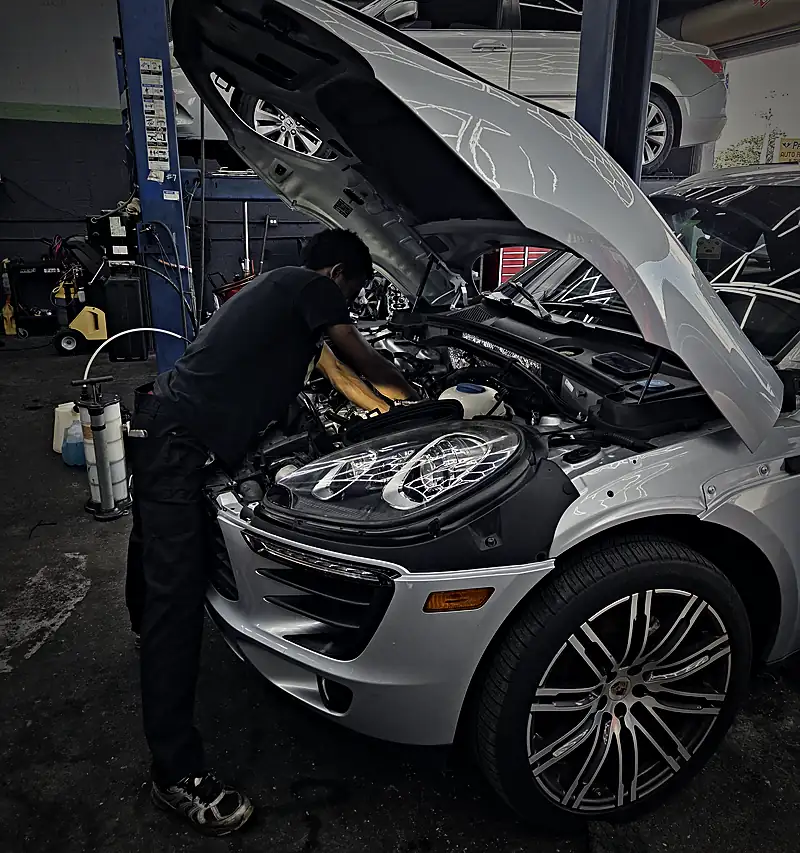
- Scan every control unit with PIWIS-level tools and save the transmission fault codes and the conditions when each one set.
- Test the 12-volt battery and charging system, because low voltage changes how the other codes are read.
- Read the PDK data: clutch values and adaptations, sensor signals, pressures and fluid temperature.
- Inspect the gearbox for leaks, and check the wiring and connector.
- Road test with data recording when the fault is intermittent, then test the suspect part directly.
- Send photos and a written estimate that names the cause before any repair starts.
What to do next
- Write down the full message, including any instruction about reverse or parking the car.
- Note what the car was doing: cold start, slow traffic, hard driving, or first drive after sitting.
- Do not clear the codes or disconnect the battery.
- Book a diagnosis through our Porsche PDK service page, or request an estimate and include the exact wording on the screen. Our transmission repair page covers the other gearbox types we work on.
See Porsche repair in Fort Lauderdale for the models and systems we work on. Bring the car to 250 NE 44th St in Oakland Park, open 7 days from 8 AM to 7 PM, (954) 303-0758, or to 930 NE 4th Ave in Fort Lauderdale, Monday to Saturday from 8 AM to 7 PM, (954) 562-8045.
Related repair services
- Porsche PDK service in Fort Lauderdale
- Engine repair in Fort Lauderdale
- Oil leak repair in Fort Lauderdale
- Timing chain replacement in Fort Lauderdale
- Audi timing chain replacement in Fort Lauderdale
- Transmission repair in Fort Lauderdale
- Mercedes transmission repair in Fort Lauderdale