Shocks and struts replacement in Fort Lauderdale restores the control your car had when it was new. Dampers do not hold the car up. Springs do that. The damper’s job is to stop the spring from bouncing, keep each tire pressed to the road and keep the body steady when you brake, turn or hit a bump. When they wear out, stopping distances grow on rough or wet roads, tires wear unevenly and the car feels loose at highway speed.
Signs of worn shocks or struts
| What you notice | What it usually means |
|---|---|
| The car bounces more than once after a bump or driveway | Dampers have lost their hydraulic control |
| Nose dives when braking, rear squats when accelerating | Worn front or rear dampers |
| Sways or leans in lane changes and on ramps | Weak damping, sometimes with worn sway bar links |
| Clunk or knock over bumps | Worn strut mount, loose top nut, or a worn bushing or link nearby |
| Creak or “boing” when turning the wheel at low speed | Strut bearing binding, or a broken coil spring |
| Oil on the shock or strut body | A leaking seal. Light misting is normal, a wet streak is not |
| Tires worn in scalloped or cupped patches | The tire is hopping on the road, usually from weak damping |
| One corner sits lower | Broken coil spring, or an air strut leak on cars with air suspension |
Several of these overlap with control arm bushings, ball joints and sway bar links. That is why we inspect the whole corner before quoting a damper. Our suspension repair in Fort Lauderdale page covers those parts, and the car noises guide helps you describe what you hear.
How we inspect on the lift
- Road test on a known route to feel bounce, float, noise and steering response.
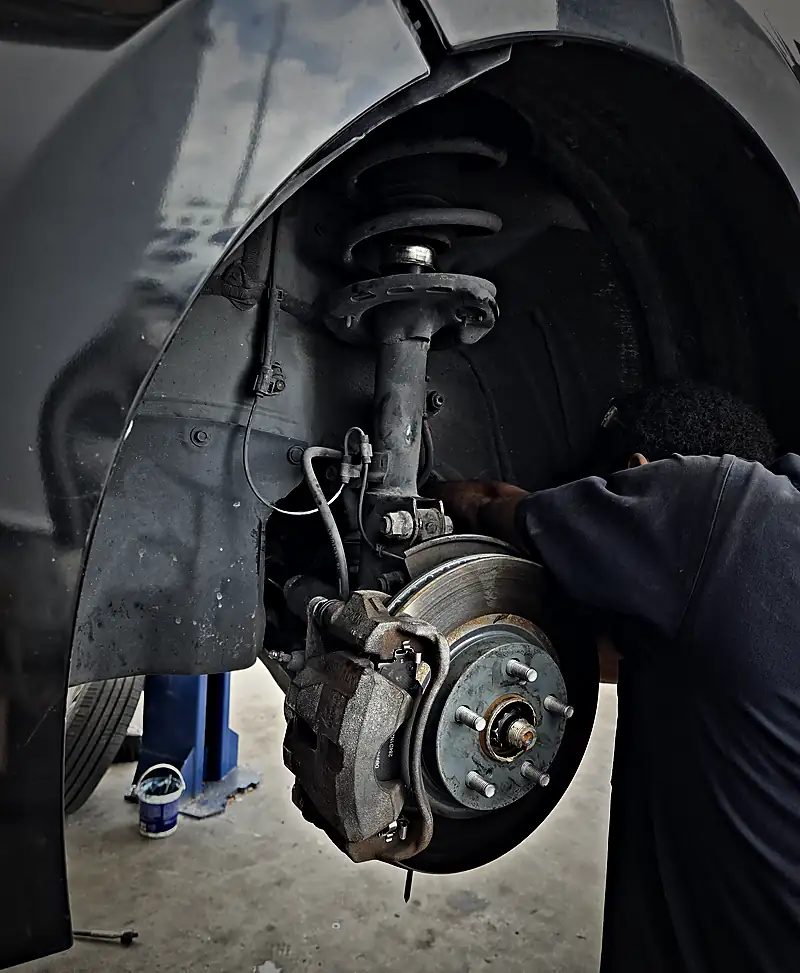
- Lift the car and check each damper for oil leaks, dents in the body and a bent or pitted piston rod.
- Check mounts and bearings. Upper strut mounts crack and separate, and the bearing that lets the front strut turn with the steering can seize.
- Check the springs for breaks, which often happen at the lowest coil where water and grit collect in the spring seat.
- Check bump stops and dust boots. A torn boot lets grit reach the rod seal, and a crumbled bump stop lets the strut bottom out.
- Read the tires for cupping and uneven wear, and measure tread depth across each tire.
- Scan the suspension module on cars with adaptive dampers or level sensors.
- Send photos and a written estimate before any work.
What gets replaced
- Shocks or struts, in axle pairs. OEM or OE-equivalent parts matched to your car’s suspension option. Sport, standard and adaptive suspensions use different part numbers, so we order by VIN.
- Strut mounts and bearings when worn. The strut has to come apart to change them, so replacing a worn mount during the same job avoids doing the labor twice.
- Bump stops and dust boots, which are inexpensive and protect the new damper.
- Coil springs when broken or sagging, also in pairs.
- Hardware. Many European makers call for new stretch bolts and self-locking nuts on suspension joints. We follow that and torque suspension bushings with the car at ride height, so the rubber is not twisted when the car sits on its wheels.
After the parts are in, we perform a wheel alignment and road test again.
Shocks vs struts: which does your car have
Most cars use a mix. A common layout is MacPherson struts in front and separate shocks and springs in the rear. Many BMW, Mercedes-Benz and Audi models use multi-link or double-wishbone front suspension, where the damper and spring form a coilover unit that does not steer. Trucks and body-on-frame SUVs often have front coilovers and rear shocks. The layout matters because it sets how much labor is involved and whether an alignment is required. We confirm what your car has on the lift.
Adaptive, electronic and air dampers
Many of the cars we see every day do not have simple hydraulic shocks.
- Electronically adjustable dampers. BMW EDC and Adaptive M suspension, Mercedes ADS, Porsche PASM, Audi adaptive damping and Volvo Four-C use a valve on each damper that the car controls. A failed valve or a broken wire sets a chassis warning and can leave the damper in its firmest setting.
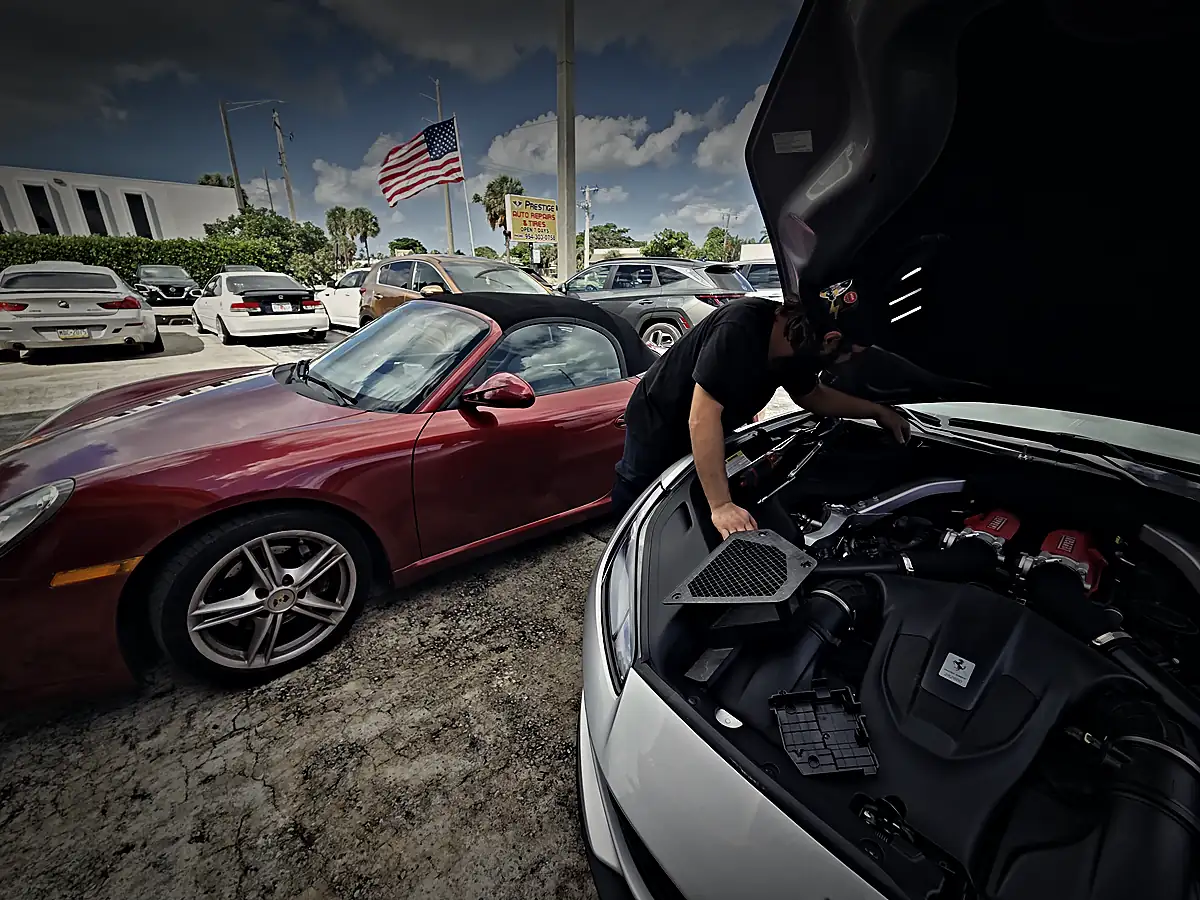
- Magnetic dampers. GM Magnetic Ride Control on Corvette, Cadillac and some trucks and SUVs, Audi magnetic ride and some Ferrari models use a fluid that stiffens in a magnetic field. They leak like any damper and are replaced as a unit.
- Air struts. Mercedes AIRMATIC, Range Rover, Porsche and Audi air suspension combine the air spring and damper in one strut. See air suspension repair for those.
- Hydraulic systems. Mercedes ABC and McLaren’s linked hydraulic suspension are diagnosed with factory-level software before any parts are ordered.
After replacement, the suspension module often needs fault codes cleared and, on some cars, a ride-height calibration. We do that with the same factory-level tools we use for diagnosis.
Why South Florida is hard on shocks and struts
Heat hardens the rubber in strut mounts and bushings. Speed bumps in parking garages and gated communities, steep driveway aprons, railroad crossings and flooded streets that hide potholes all deliver sharp hits. Near A1A and the Intracoastal, salt air rusts spring seats and lower spring coils, which is where springs tend to break. Heavy EVs put more load on dampers than a gasoline car of the same size, and large wheels with low-profile tires pass more of each impact into the suspension.
What to expect on your visit
Walk in at either shop or request an estimate. You get photos of each worn part and a written estimate before any work. If only one axle is worn, we say so. Work is done by ASE-certified technicians and carries a 2-year / 24,000-mile warranty.
- Oakland Park: 250 NE 44th St, open 7 days, 8 AM to 7 PM, with a 24-hour key drop box at the front door. Call (954) 303-0758.
- Fort Lauderdale: 930 NE 4th Ave, open Monday to Saturday, 8 AM to 7 PM, closed Sunday. Call (954) 562-8045.
We speak English and Spanish at both shops.
Part of our brakes, suspension and tires guide: Suspension repair in Fort Lauderdale