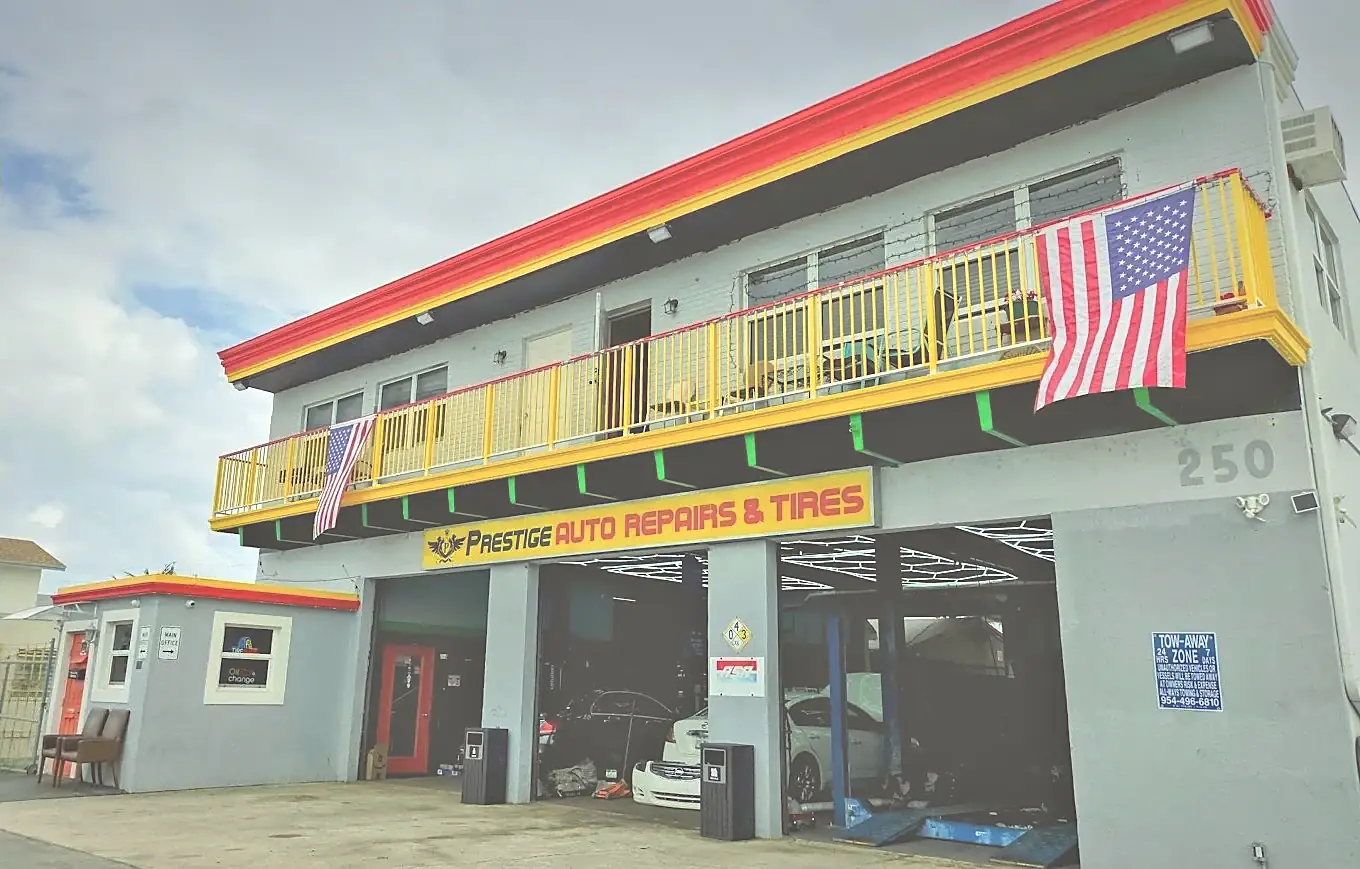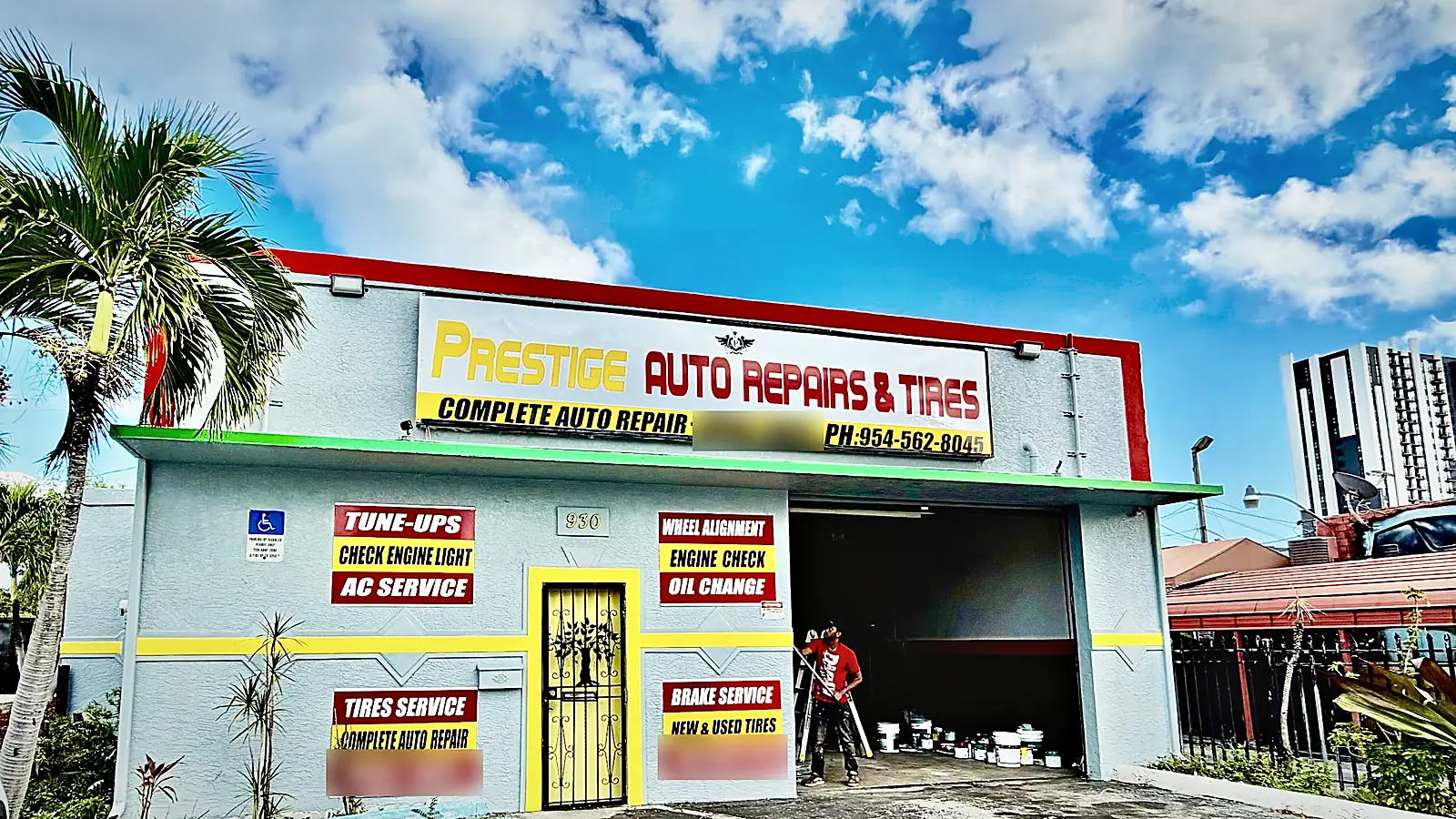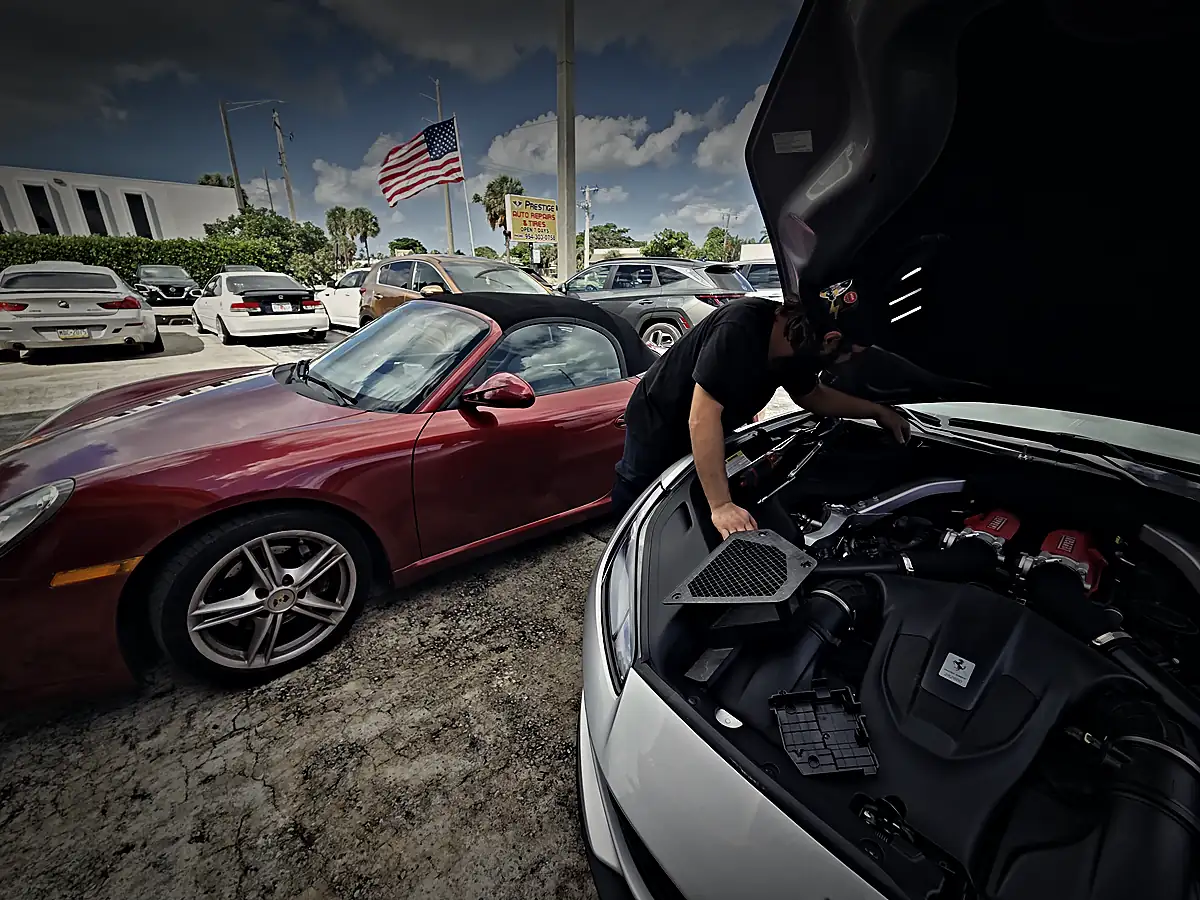
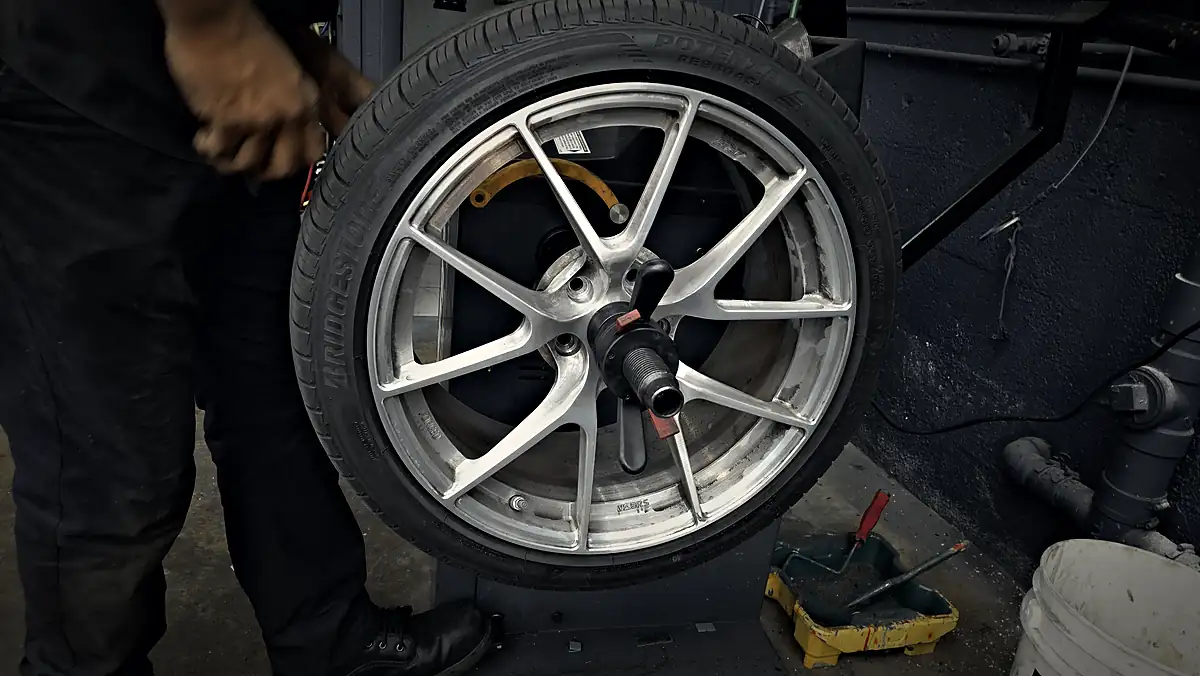
Choosing tires in Fort Lauderdale comes down to three things: heat, rain and the car. Prestige Auto Repairs & Tires fits, road-force balances and aligns tires for European, exotic and electric cars at two Broward shops, and we match the tire to the OE marking, load rating and speed rating your car was built for. Every set comes with a TPMS check, a photo of the old tires and a written estimate before any work. Oakland Park is open 7 days and Fort Lauderdale Monday to Saturday.
Pavement on I-95 and Federal Highway reaches well over 140°F on a summer afternoon, and then a storm drops an inch of rain in twenty minutes. A tire that is right for Ohio is often wrong here. This is how we think about the choice.
Start with heat: the temperature and treadwear grades
Every passenger tire sold in the US carries a UTQG rating on the sidewall: treadwear, traction and temperature. For South Florida the temperature grade matters most. Grade A means the tire resists heat build-up at sustained highway speed; B and C tires run hotter and age faster. Almost every quality tire is an A, but some budget tires are not. Check before buying.
Treadwear is a relative number. A 300 tire wears roughly half as fast as a 600 tire in the same test. Performance summer tires sit around 200 to 300 and grip hard, touring all-seasons sit at 500 to 700 and last longer. Heat shortens both. A soft summer tire on a Porsche or AMG can be done in 15,000 miles of Broward driving, and that is normal, not a defect.
Heat also ages rubber that is not even rolling. We treat six years from the DOT date code as the end of a tire’s life here regardless of tread, because sidewall cracking and belt separation show up in this climate long before the tread wears out.
Then rain: traction grade and tread design
Afternoon storms leave standing water across all three lanes of Sunrise Boulevard, and hydroplaning is the most common cause of the single-car losses we see in body work. Two things resist it:
- Traction grade AA or A. This measures wet braking on a government test track. A B tire stops noticeably longer in the rain.
- Deep, wide circumferential grooves. They channel water out from under the contact patch. Once a tire is down to 4/32” of tread the grooves are shallow and wet grip drops fast, well before the 2/32” legal minimum. We recommend replacing at 4/32” in Florida.
A true summer tire is the strongest in rain when it is new, because it has the softest compound and the most open grooves. An all-season with a high treadwear number is a good compromise for daily commuting. Avoid winter tires entirely; their compound overheats here.
Match the car: OE markings and what they mean
European makers approve specific tires for each model, and the approval is molded into the sidewall:
| Marking | Maker | What it means |
|---|---|---|
| ★ (star) | BMW and MINI | Tuned for BMW suspension, often run-flat |
| MO, MOE, MO1 | Mercedes-Benz and AMG | MOE is a Mercedes run-flat |
| N0, N1, N2 … | Porsche | Each N number is a tire revision Porsche tested on that model |
| AO, RO1 | Audi and Audi RS | RO1 is the RS-specific tire |
| T0, T1, T2 | Tesla | Foam-lined for noise, with the load rating the car needs |
The same tire name from the same brand can have a different compound and sidewall stiffness with and without the marking. Mixing a marked and unmarked tire on one axle can make stability control intervene when it should not. We fit the marked tire unless you ask otherwise and understand the trade-off.
Run-flats on BMW and MINI
Most BMWs and MINIs leave the factory on run-flat tires and without a spare. Run-flats have reinforced sidewalls that carry the car about 50 miles at reduced speed after a puncture. The trade-offs are a firmer ride, more road noise and a higher replacement cost, and they cannot be repaired after being driven flat.
Switching to conventional tires is common and safe when all four are changed together and an inflator kit rides in the trunk. The suspension and TPMS work the same. What you lose is the ability to drive on after a flat, which matters more on a late-night stretch of I-95 than in town. Many of our BMW owners switch at the first replacement; some keep run-flats for the peace of mind. Either is a reasonable choice.
Staggered Porsche, AMG and M sizes
A 911, a C63 or an M4 runs wider tires on the rear than the front. That means no front-to-rear rotation, so the rears wear two to three times faster than the fronts. Plan on buying rear pairs on their own schedule. Keep the same model and tread pattern at all four corners, because a different rear compound changes the car’s balance in the wet.
On heavy performance SUVs such as the Cayenne, GLE 63 and X5 M, factory camber plus the weight means the inner rear edge wears first. Checking alignment once a year keeps that in range. Our Porsche repair team sees this on nearly every Macan and Cayenne that comes in on worn tires.
EV tires: load rating and fast wear on Tesla
An electric car is heavy, quick and quiet, and all three change the tire conversation. A Model Y or a Rivian R1S needs an XL (extra load) tire with the correct load index, because the battery pack puts the car near the top of what a standard tire carries. Fitting a standard-load tire of the same size is not safe.
Instant torque works the tread hard, and Tesla’s factory rear camber adds inner edge wear. Rotate every 6,000 miles, check pressure monthly (EVs are sensitive to it and often spec 42 psi or more) and align yearly. The foam liner inside T-marked tires reduces cabin noise and does not affect repairs. We lift EVs on the battery-safe jack points and use the correct torque on the wheel bolts. See our Tesla and EV repair page for the rest of what we do on them.
TPMS: the sensor inside every wheel
Every car built for the 2008 model year or later has a tire pressure sensor in each wheel. The sensor’s battery lasts 7 to 10 years, and Florida heat tends to take it to the short end. When we mount tires we scan every sensor for battery state and signal before the old tire comes off, so a weak sensor is replaced while the wheel is already apart. Each new sensor is programmed and the relearn is done so the light stays off. Details are on our TPMS sensor replacement page.
Road-force balancing and the alignment question
A spin balance only corrects weight. A road-force balancer presses a load roller against the spinning tire and measures stiffness variation around the circumference, then tells us how to index the tire on the wheel. On low-profile 19 to 22 inch tires this is the difference between a smooth 75 mph and a steering wheel shimmy.
After tires are on, we look at how the old set wore. Even wear and a straight-driving car need only a check. Inner edge wear, feathering or cupping means the new set will wear the same way unless the cause is found. Sometimes that is an alignment; sometimes it is a worn thrust arm bushing or a tie rod end that no alignment can fix. Our steering and suspension repair page covers those parts, and our guide on why cars keep losing alignment explains what to ask before paying for another alignment.
When to replace
- Tread at 4/32” or below (a quarter inserted head first shows the top of Washington’s head)
- DOT date code older than six years
- Sidewall cracking, bulges or a cord showing
- A puncture in the shoulder or sidewall, or any run-flat driven flat
- Vibration that balancing does not cure, which often means a separated belt
Where to get tires in Fort Lauderdale and Oakland Park
Both shops stock common sizes and source OE-marked performance and EV tires on request. Walk-ins are welcome at the Fort Lauderdale tire and alignment shop at 930 NE 4th Ave, Monday to Saturday 8 AM to 7 PM, and at the Oakland Park tire shop at 250 NE 44th St, open 7 days with a 24-hour key drop. Send your tire size or VIN through our estimate form and we will quote the right tire, mounted, balanced and TPMS checked, in writing before you commit.
Related repair services
- Tire shop in Fort Lauderdale
- Suspension repair in Fort Lauderdale
- Brake repair in Fort Lauderdale
- Wheel bearing replacement in Fort Lauderdale
- Tpms sensor replacement in Fort Lauderdale
- Air suspension repair in Fort Lauderdale
- Mercedes AIRMATIC repair in Fort Lauderdale
More car care guides on this topic
- What Causes Uneven Front Brake Pad Wear in Oakland Park, FL
- Why Does Your Car Keep Losing Alignment? The Problems an Alignment Alone May Not Fix
- Common Driving Problems a Wheel Alignment Can Solve in Oakland Park, FL
- What to Expect During a Professional Front Brake Pad Replacement Service Appointment
- Avoid Brake Failure: The Warning Signs That Your Front Brake Pads Need Replacing
- How Front Brake Pads Affect Your Vehicle's Safety and Performance