Brakes rarely fail without warning. They squeal, they grind, the pedal feels different or a light appears on the dash. The trick is knowing which signs mean “book soon” and which mean “stop driving.” This guide sorts them out for owners of European, exotic and EV models in Broward.
Why the front brakes take most of the load
Every time you slow down, the car’s weight pitches forward. The front tires press harder into the road, so the front brakes do most of the stopping work. That is why front pads and rotors are larger, run hotter and wear out first. In stop-and-go traffic on US-1, Sunrise Blvd or Oakland Park Blvd, they get very little rest.
Heavy cars wear brakes faster still. A Range Rover, an AMG G63 or a Rolls-Royce Ghost asks a lot of its front brakes on every stop.
Warning signs you can hear
High-pitched squeal
Many pads have a small metal tab that squeals when the friction material is getting low. A squeal that appears only in the morning on damp rotors and then disappears is often surface rust and is less concerning. A squeal that stays with you all day is a request for an inspection.
Grinding or scraping
Grinding usually means the pad material is gone and the steel backing plate is touching the rotor. Now each stop is cutting into the rotor. Book right away and drive gently until then.
Clicking or clunking when you brake
This can point to loose pad hardware, a worn caliper bracket or a loose component. It deserves a look before it turns into a vibration.
Warning signs you can feel
- Soft or spongy pedal. Air or moisture in the brake fluid, or a leak. Treat this as urgent.
- Pedal sinks slowly while held. A possible master cylinder problem. Do not delay.
- Vibration through the pedal or steering wheel. Uneven rotor thickness or pad deposits on the rotors.
- Car pulls to one side under braking. A sticking caliper or uneven pad wear on one side.
- Longer stopping distances. Worn pads, glazed pads or overheated fluid.
Warning lights on the dash
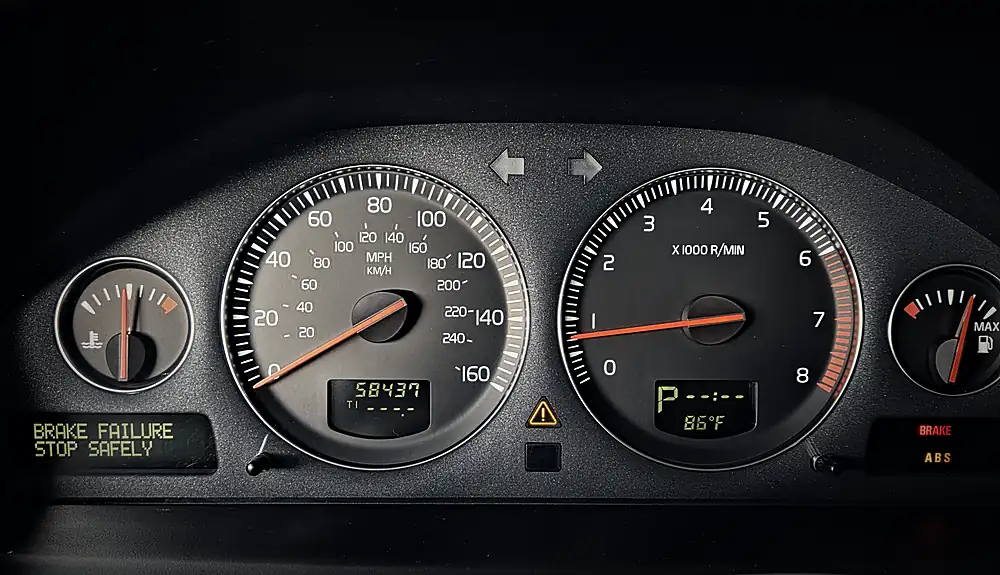
Modern cars tell you a lot if you know the symbols:
- Brake pad wear light (a circle with dashed lines on each side, common on BMW, Mercedes-Benz, Audi, VW and Porsche): the wear sensor has made contact.
- Red BRAKE or (!) light: low brake fluid, a hydraulic problem or the parking brake still applied. Check right away.
- ABS or stability control light: often a wheel speed sensor, but the anti-lock system is not working properly while it is lit.
- Electronic parking brake fault: common on cars with motors on the rear calipers.
How urgent is each sign
| Sign | Likely cause | What to do |
|---|---|---|
| Wear light only | Pads near the limit | Book within days |
| Constant squeal | Wear indicator or glazed pads | Book soon |
| Grinding | Pads worn to the backing plate | Book now, drive gently |
| Vibration when braking | Rotor thickness variation | Book soon |
| Soft or sinking pedal | Fluid, leak or master cylinder | Stop driving and call us |
| Red brake light | Low fluid or hydraulic fault | Stop and check fluid, call us |
What we measure before recommending anything
A warning sign is a reason to measure, not a verdict. At the inspection we record:
- Pad thickness on the inner and outer pad of each wheel, in millimeters. New pads start around 10 to 12 mm; the usual replacement point is about 3 mm.
- Rotor thickness with a micrometer against the minimum cast into the rotor hat, plus runout if there is a vibration.
- Caliper slide pins and hardware, which seize in Broward humidity and cause one pad to wear faster than its partner.
- Brake fluid moisture content and level, since fluid that has absorbed water boils early in a hot, hard stop.
You get the numbers and the photos with the estimate, so “book soon” and “book now” are based on measurements rather than a noise.
Florida specifics: morning rust and electric cars
Two local patterns confuse owners. A light scrape on the first few stops of a humid morning is surface rust being wiped off the rotors and is normal; a noise that lasts the whole drive is not. Our guide to brake squeal versus grinding sorts the sounds. On hybrids and EVs, regenerative braking does most of the slowing, so the friction brakes sit damp and rust faster than they wear; a seized caliper on a low-mileage Tesla or Lexus hybrid is common here. Cars parked near the beach add salt to the mix, which our salt air corrosion guide covers.
Pad choices for European and exotic cars
European cars often come from the factory with low-metallic pads. They bite hard and handle high heat, but make more dust. Ceramic aftermarket pads run cleaner and quieter, but must suit the car’s weight and rotor design. Performance models such as Porsche with PCCB carbon-ceramic brakes or AMG models with large multi-piston calipers need the correct pads for that system. We list the options on your estimate so you can choose.
What not to do
- Do not ignore a wear light because the brakes “still feel fine.”
- Do not replace pads on one side only. Pads are always replaced in axle sets.
- Do not reuse a wear sensor once it has triggered.
- Do not keep driving on grinding brakes to “get a bit more out of them.”
Get your brakes checked
If you notice any of these signs, Prestige Auto Repairs & Tires can inspect your brakes at our Oakland Park or Fort Lauderdale shop (Oakland Park 7 days a week, Fort Lauderdale Monday to Saturday). You get photos of your pads and rotors and a written estimate before any work, and brake repairs carry our 2-year / 24,000-mile warranty. See our brake repair service or request an estimate today.
Related repair services
- Brake repair in Fort Lauderdale
- Suspension repair in Fort Lauderdale
- Tire shop in Fort Lauderdale
- Wheel bearing replacement in Fort Lauderdale
- Shocks and struts replacement in Fort Lauderdale
- Tpms sensor replacement in Fort Lauderdale
More car care guides on this topic
- Range Rover Air Suspension Warning: Causes and Fixes
- Brake Noise on I-95 and Turnpike Commutes: Squeal vs Grind and What Each Sound Means
- Tires in Fort Lauderdale: How to Choose Tires That Survive South Florida Heat and Rain
- What Causes Uneven Front Brake Pad Wear in Oakland Park, FL
- Why Does Your Car Keep Losing Alignment? The Problems an Alignment Alone May Not Fix
- Common Driving Problems a Wheel Alignment Can Solve in Oakland Park, FL