A Range Rover air suspension warning means the suspension computer has seen something it cannot correct: a corner that will not reach its height, pressure that builds too slowly, or a sensor reading that makes no sense. The most common cause is an air leak at one corner, and the most common mistake is ignoring it until the compressor fails as well. Range Rover owners in Delray Beach and Boynton Beach bring these faults to Prestige Auto Repairs & Tires in Oakland Park, the nearer of our two shops, for Range Rover air suspension repair that starts with testing, not parts.
What the messages mean
The wording changes a little by model and year, but the messages fall into a few groups:
- “Suspension fault” on its own: a fault is stored, and the system may still be holding the car level.
- “Suspension fault, normal height only”: the system has locked itself at standard ride height. Access and off-road heights are switched off so it does not make things worse.
- A message with a reduced maximum speed: the car is sitting lower than it should, or the system cannot confirm its height, so it asks you to slow down.
- A message telling you to stop: the system cannot keep the body at a safe height.
Amber or red
Land Rover uses the same color logic as most makers. An amber warning means a fault that needs attention soon: the car has usually limited what the suspension will do, and you should drive gently and have it checked. A red warning means stop when it is safe. On the suspension, red generally comes with a body that is very low or not level. Your owner’s handbook lists the exact messages for your model; our dashboard warning lights guide covers the other lights that may appear with it.
The usual causes
| Part | What it does | How it tends to fail |
|---|---|---|
| Air struts and air springs | Hold the car up on a rubber bellows filled with air | The rubber cracks along its folds, or the seal at the top or bottom leaks |
| Compressor | Makes the pressure | The piston seal wears and it builds pressure slowly, usually after overwork |
| Valve block | Sends air to each corner and holds it there | A valve sticks or seeps, so a corner drops or will not rise |
| Height sensors | Tell the computer how high each corner sits | The sensor or its link arm wears, corrodes or gets knocked |
| Air lines and fittings | Carry air between the parts | A line chafes through or a fitting seal hardens |
| Reservoir | Stores pressure so height changes are quick | Leaks at its fittings, or corrosion on older cars |
| Compressor relay and fuse | Switch power to the compressor | Contacts burn after long run times; the compressor then does not run at all |
The compressor also has an air dryer and an exhaust valve. When the dryer is saturated, moisture travels into the valve block and lines, which is one reason a neglected system collects several faults at once.
Why the car sags overnight
While you drive, the compressor and reservoir top up any corner that loses air, so a small leak is invisible. Once the car is parked and the system goes to sleep, nothing replaces the air that escapes. By morning one corner, or one end of the car, sits low. Start the engine and it rises again.
Leaks often show up first when the car has sat for a while, because the cracks in an aging bellows open at the folds as the rubber settles. If it is always the same corner that drops, the leak is almost always in that corner’s spring, its line or its valve.
Why the compressor fails after a leak is ignored
The compressor is built to run in short bursts and then cool. With a leak, it runs longer and more often to keep the car at height. It overheats, the piston seal wears, and it takes longer still to build pressure, so it runs even more. In the end the module reports that pressure is rising too slowly, or the relay burns and the compressor stops.
That is how one leaking air spring turns into an air spring, a compressor and a relay. Fixing the leak early is the less expensive repair in nearly every case.
What is safe to drive on, and what is not
Generally fine for a short, gentle trip to a shop:
- An amber message with the car level and close to normal height
- Access or off-road height unavailable, but normal height holding
- A corner that was low in the morning and came back up after start-up
Do not keep driving:
- A corner or an axle sitting on its bump stops
- A car that leans to one side or will not rise after start-up
- A red message, or a message telling you to stop
- A tire touching or close to the wheel arch
A car riding on its bump stops has almost no suspension travel. The ride is harsh, the steering and braking feel different, and a tire that rubs the arch can be damaged. If your Range Rover is in that state, park it and call the shop before moving it; we can arrange pickup through our concierge service.
How we diagnose it
- Scan data. We read the suspension module with Land Rover-capable software: stored and current faults, the height each sensor reports, reservoir pressure and how the compressor is behaving.
- Height readings. We measure each corner and compare it with what its sensor says. A sensor that disagrees with the tape measure is its own fault. When the complaint is overnight sag, we record the heights, leave the car parked and measure again.
- Leak test. With the system pressurized we check each spring, line, fitting and the valve block with leak-detection spray or an electronic detector.
- Compressor check. We time how long the compressor takes to raise the car and check its relay and fuse.
- Photos and a written estimate. You see the cracked bellows or the bubbling fitting on your phone, with the cause named, before any repair is approved.
Repair options in plain terms
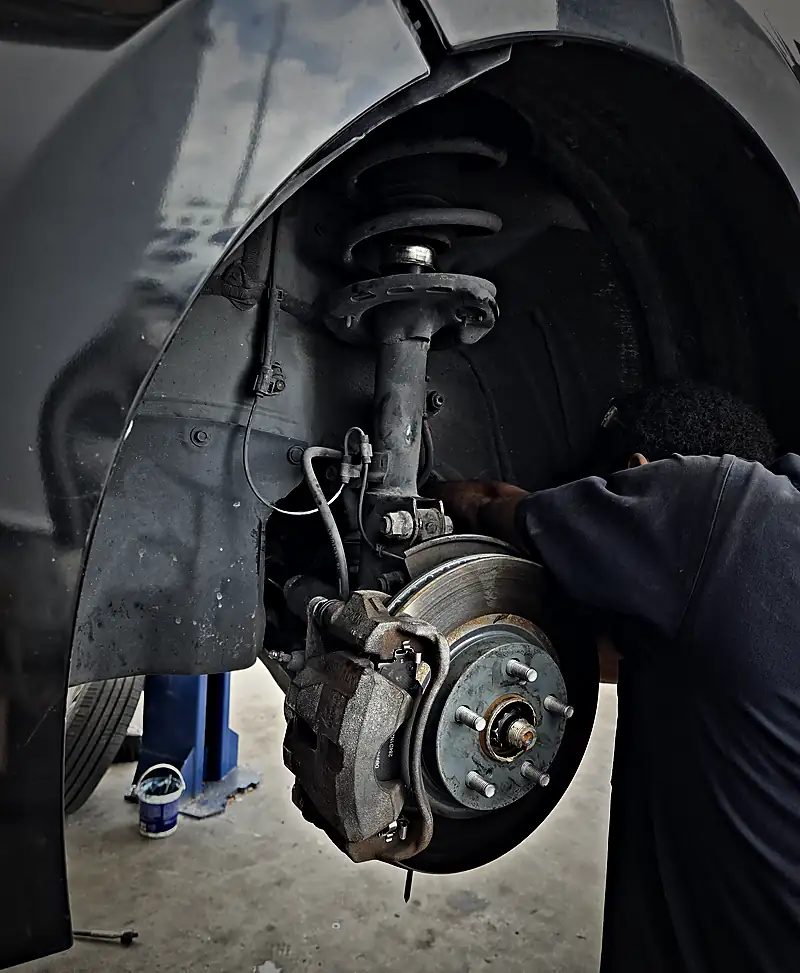
- Replace the leaking spring or strut. At the front the air spring and shock absorber are usually one unit. Genuine Land Rover parts and units from established aftermarket suspension makers both exist for most models; we explain the choices and the warranty on each.
- Replace the compressor, normally with a new relay, once the leak that wore it out is fixed.
- Replace or reseal the valve block when a valve is the part that leaks.
- Replace a height sensor or link, then calibrate ride height.
- Repair an air line or fitting. Often the smallest job on the list.
After any of these, the ride height is calibrated with the scan tool and the car is driven through its height modes. Our general air suspension repair page covers the same systems on other makes.
Coming from Delray Beach or Boynton Beach
We do not have a shop in Palm Beach County. Drivers from Delray Beach and Boynton Beach use the Oakland Park shop at 250 NE 44th St, open 7 days, 8 AM to 7 PM, (954) 303-0758. Take a photo of the dash message when it appears and note which corner looks low; both help us find the stored fault faster. For engine, cooling and electrical faults on the same vehicle, see Range Rover repair.
Related repair services
- Range Rover air suspension repair in Fort Lauderdale
- Suspension repair in Fort Lauderdale
- Brake repair in Fort Lauderdale
- Tire shop in Fort Lauderdale
- Wheel bearing replacement in Fort Lauderdale
- Shocks and struts replacement in Fort Lauderdale
More car care guides on this topic
- Brake Noise on I-95 and Turnpike Commutes: Squeal vs Grind and What Each Sound Means
- Tires in Fort Lauderdale: How to Choose Tires That Survive South Florida Heat and Rain
- What Causes Uneven Front Brake Pad Wear in Oakland Park, FL
- Why Does Your Car Keep Losing Alignment? The Problems an Alignment Alone May Not Fix
- Common Driving Problems a Wheel Alignment Can Solve in Oakland Park, FL
- What to Expect During a Professional Front Brake Pad Replacement Service Appointment