The EPC light on an Audi or Volkswagen means the Electronic Power Control system, which runs the electronic throttle, has found a fault. The car will usually cut engine power to protect itself, and the fix can be as small as a brake light switch or as involved as a throttle body, so the stored fault codes need to be read before any part is bought.
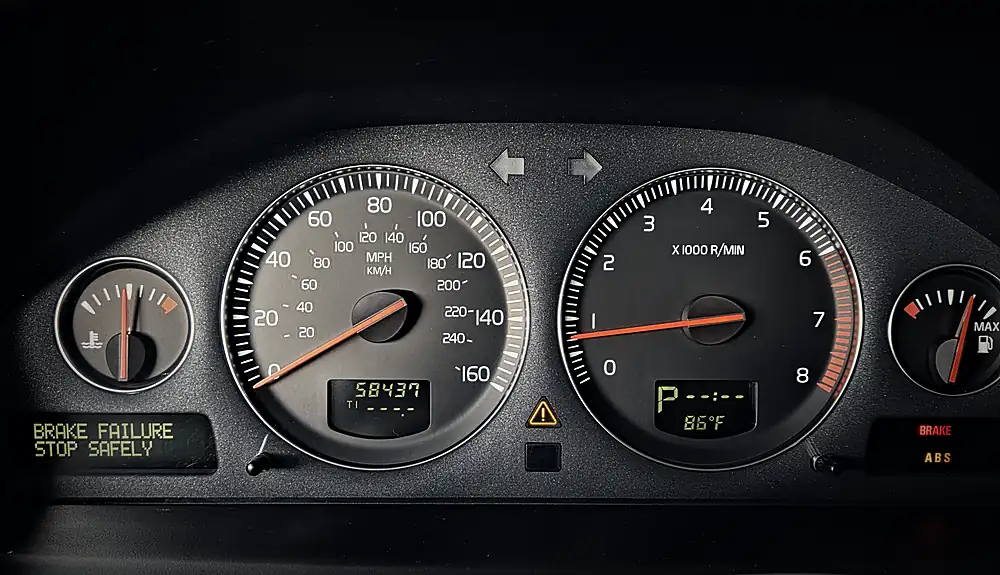
EPC is a Volkswagen Group warning. You will see it on Volkswagen, Audi and other brands in the group, usually as amber letters in the instrument cluster. Other makes report the same kind of fault through the check engine light alone.
What the EPC system does
These cars have no cable between the accelerator pedal and the engine. Two sensors in the pedal tell the engine computer how far your foot has moved. The computer then drives a small electric motor in the throttle body, and two more sensors there report how far the throttle plate actually opened.
The computer compares all of these readings many times a second. It also watches signals that affect how much power is safe to deliver: the brake pedal switch, engine speed, airflow, boost pressure, and wheel speed from the ABS and stability control. When two readings that should agree do not, it turns on the EPC light. Often it also stores a code that lights the check engine light.
Common causes of an EPC light
| Symptom you notice | What it usually is | What we check |
|---|---|---|
| Light with rough idle, stalling or slow response | Throttle body dirty, sticking or failing | Both throttle position readings against the commanded opening, then a throttle adaptation after cleaning or replacement |
| Light comes and goes, dead spots in the pedal | Accelerator pedal position sensor | The two pedal sensor signals side by side while the pedal is moved slowly |
| Light with cruise control not working, or brake lights stuck on or off | Brake light switch | Switch signals in live data, and the brake lights themselves |
| Light with shaking and a flashing check engine light | Misfire from an ignition coil or worn spark plugs | Misfire counters by cylinder, coil and plug condition |
| Light with low power, sometimes a whoosh or whistle | Boost or intake leak on a turbo engine | Smoke test of the intake, requested against actual boost pressure |
| Light with ABS or traction control warnings | Wheel speed sensor or ABS fault | Codes in the brake module, live wheel speed on a road test |
| Several lights at once after a slow start | Low battery voltage | Battery, charging system and main ground connections |
This table shows where the search usually starts, not where it ends. The same code can come from the part, its connector or the wiring between them. Generic codes such as P2135 (throttle position sensors do not agree), P2138 (pedal position sensors do not agree), P0571 (brake switch circuit) and P0299 (turbo underboost) name the signal the computer distrusts. They do not name the failed part.
Which causes are likely depends on the engine and the year. A turbocharged four-cylinder has boost hoses and a diverter valve that an older non-turbo engine does not have, and switch and sensor designs changed between generations. Our common Audi problems guide covers the engine-specific faults in more detail.
What limp mode feels like
When the computer cannot trust the throttle system, it falls back to a protective mode, often called limp mode. The engine may respond slowly to the pedal, refuse to rev past a set point, or hold the transmission in one gear. This is deliberate. A car that cannot confirm how far its throttle is open should not deliver full power.
Limp mode often clears when you switch the engine off and restart it. That does not mean the fault is gone. The code remains in memory, along with freeze-frame data: a snapshot of speed, engine load and temperature at the moment the fault set.
Can I keep driving with the EPC light on?
It depends on what else is happening.
Usually fine for a short, gentle drive to a shop:
- The EPC light is steady, the engine runs smoothly and acceleration feels normal or only slightly reduced.
- The light went out after a restart and has not come back.
Stop somewhere safe and call before driving further:
- The check engine light is flashing or the engine is shaking. That is an active misfire, which can overheat the catalytic converter.
- Power is cut so far that you cannot keep up with traffic.
- The light came with a temperature or oil pressure warning.
- Your brake lights are not working. Ask someone to stand behind the car while you press the pedal. Drivers behind you cannot tell you are slowing down, so this is a safety problem in its own right.
If you do drive, stay off the highway, leave extra room and avoid hard acceleration. Do not disconnect the battery to reset the light. That erases the stored data a technician uses to find the cause.
How a shop diagnoses an EPC light
At Prestige Auto Repairs & Tires an EPC diagnosis follows a set order:
- Scan every module, not only the engine. An EPC fault can start in the ABS or the body electronics, so we read them all with ODIS-level software and save the codes and freeze-frame data before anything is cleared.
- Read the paired sensors in live data. Pedal sensor 1 against pedal sensor 2, and throttle sensor 1 against throttle sensor 2. A pair that drifts apart as the pedal moves points to that component or its wiring.
- Check the brake switch signals and the brake lights. This takes a few minutes and rules a common cause in or out early.
- Test what the codes point to. That can mean a smoke test for intake and boost leaks, misfire counters and coil checks, a battery and charging test, or a wiring check at a connector.
- Road test under the conditions recorded in the freeze frame, when the fault is intermittent.
- Send photos and a written estimate that names the cause. Work starts after you approve it.
After a throttle body is cleaned or replaced, the computer has to relearn its end stops. This is a throttle adaptation, done with the scan tool. If it is skipped, the idle can hunt and the light can come back.
What to do right now
- Note what was happening when the light came on: cold start, hard acceleration, rain, or right after refuelling.
- Check the brake lights with a helper.
- Look at which other lights are on. The combination narrows the search. Our dashboard warning lights guide explains each one.
- Leave the codes in place and book a check engine light diagnosis.
Both shops work on these brands. See Audi repair and Volkswagen repair for what we handle on each brand, or request an estimate and tell us which lights are on. The Oakland Park shop at 250 NE 44th St is open 7 days, 8 AM to 7 PM, phone (954) 303-0758. The Fort Lauderdale shop at 930 NE 4th Ave is open Monday to Saturday, 8 AM to 7 PM, phone (954) 562-8045.
Related repair services
- Check engine light diagnostics in Fort Lauderdale
- Mercedes check engine light in Fort Lauderdale
- Hybrid battery diagnosis in Fort Lauderdale
- Auto electrical repair in Fort Lauderdale
- Car battery replacement in Fort Lauderdale
More car care guides on this topic
- BMW chassis stabilization malfunction: causes and what to do
- BMW drivetrain malfunction: causes and what to do
- BMW VANOS solenoid: symptoms, codes and repair
- Maserati check engine light: common causes
- Mercedes ESP inoperative: see operator's manual — causes and what to do
- Porsche PSM failure warning: causes and what to do