A Mercedes check engine light in Fort Lauderdale is rarely a mystery once the car is read properly. The light means the engine computer has stored a fault that can affect emissions or the way the engine runs. It does not tell you which fault, or how serious it is. Below are the causes we find most often on Mercedes-Benz models in South Florida, what each one usually means, and how to decide whether to keep driving.
Steady or flashing: what to do first
| What you see | What it means | What to do |
|---|---|---|
| Steady light, car drives normally | A fault is stored. Often emissions-related | Check the fuel cap, drive gently and have it scanned soon |
| Steady light with rough running or low power | The fault is affecting how the engine runs, or the car is in a reduced-power mode | Avoid highway speeds and bring it in promptly |
| Flashing light | Misfire severe enough to overheat the catalytic converter | Ease off, pull over where it is safe and switch off |
| Check engine light plus a red coolant temperature or oil warning | Risk of engine damage | Stop and switch off. Do not continue |
Mercedes owners also see yellow text messages in the instrument cluster. These are separate from the check engine light, but they often appear together, and we read both in the same scan.
Common causes we see on Mercedes in South Florida
EVAP and fuel cap leaks
The evaporative emissions system traps fuel vapor from the tank and feeds it back to the engine. The car checks the system for leaks, and even a small one turns the light on. Heat and age harden the fuel cap seal, and some models show a fuel cap message as well. Beyond the cap, we find leaking purge valves, cracked vapor hoses and faults in the leak detection parts near the charcoal canister. Because a vapor leak has no smell or drip you would notice, we find it with a smoke machine. The car usually drives normally with this fault.
Camshaft adjuster magnets and camshaft position sensors
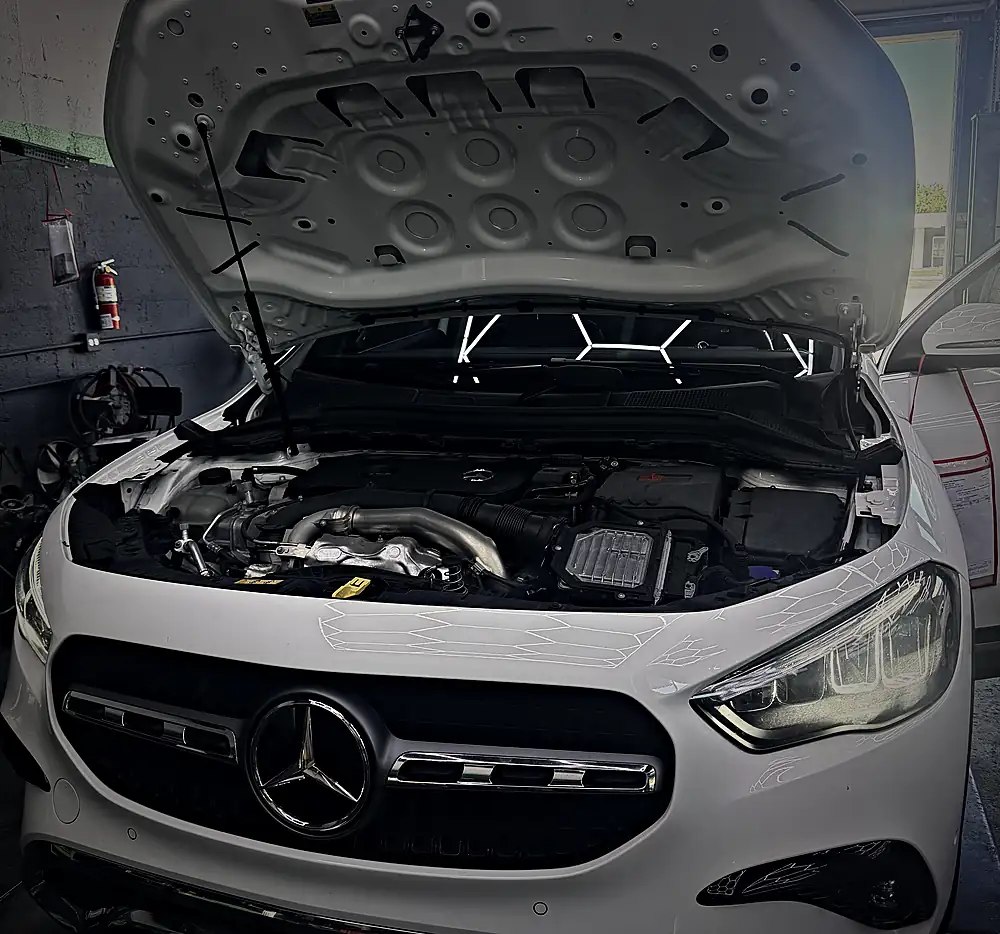
Mercedes engines vary their valve timing with oil-fed camshaft adjusters, controlled by solenoids that Mercedes calls magnets. They sit on the front of the engine, next to the camshaft position sensors. With years of heat their seals harden and oil seeps into the electrical connector. The result can be camshaft position or timing codes, a longer crank before starting, or a rough idle. On several engines, including the M274 four-cylinder, oil can travel along the wiring from that connector, so it is worth catching early. Similar codes can also come from a worn adjuster or a stretched timing chain, which is a larger repair, so we compare actual and target camshaft positions before recommending parts. See timing chain replacement for that side.
Thermostat reading low
A very common Mercedes code reports that the engine is not reaching its target temperature in the expected time. It sounds unlikely in Broward heat, but the test compares the coolant temperature with a calculated value, so the weather does not hide it. The usual cause is a thermostat stuck slightly open. Many newer engines use an electronically controlled thermostat that can also set an electrical fault. Less often the coolant temperature sensor is at fault. An engine that runs below its target temperature uses more fuel. We confirm with live temperature data on a road test before replacing the thermostat.
Oxygen sensors, catalytic converters and NOx sensors
Oxygen sensors before and after the catalytic converter report how the engine is burning its fuel. They age, and their heater circuits fail. A catalyst efficiency code may point to the converter itself, but an exhaust leak, a misfire that was left too long or a tired sensor can set the same code. We test before condemning a converter. On BlueTEC diesel models and Sprinter vans, NOx sensors and the AdBlue (DEF) system are frequent sources of a check engine light. Those faults can lead to a countdown of remaining starts, so they should not be left.
Ignition coils and spark plugs
A misfire is the most common reason for a flashing light. Coils work hard in a hot engine bay, and spark plugs have a replacement interval in the maintenance schedule that is easy to overlook. We read the misfire counters for each cylinder and swap parts between cylinders to see whether the fault follows the coil, the plug or the injector. If one coil has failed on a high-mileage engine and the plugs are due, we will say so. For the service itself, see spark plug replacement.
Intake and PCV leaks
Air that enters the engine without being measured makes the mixture lean. The typical sources on a Mercedes are crankcase breather hoses and the oil separator, which is the PCV system, along with intake manifold seals and cracked plastic intake pipes. On turbocharged engines, a leak in the charge air pipes or intercooler connections causes low boost and a loss of power as well. Rubber and plastic under the hood harden faster in constant heat. Symptoms are a rough or hunting idle, a whistle and lean mixture codes. We find these with a smoke test and fuel trim data.
Engine-specific patterns
The engine code narrows the search. Briefly:
- M274 and M264 four-cylinders in models such as the C 300, E 300 and GLC 300: camshaft magnets and oil in their connectors, and a cold-start rattle that needs the camshaft data checked.
- M272 and M276 V6: camshaft adjuster and timing faults, with the cause depending on the engine and year.
- V8 engines with turbos in the V: heat-aged coils, plugs and hoses.
- BlueTEC diesels: NOx sensors and AdBlue faults.
These are places we look first, not a diagnosis. Which faults apply depends on the model, year and engine, and the Mercedes repair in Fort Lauderdale page has a fuller table by engine.
How a XENTRY diagnosis differs from a parts-store code read
A generic code reader connects to the engine computer and returns a standard OBD-II code. That is useful, but a code names the circuit or system that reported a problem. It does not name the failed part.
With Mercedes XENTRY we can:
- Read every control unit, not only the engine, including the transmission, the body electronics and the gateway that links them. A fault in one unit often explains a code in another.
- See Mercedes-specific fault entries with their status, current or stored, how often they occurred and the conditions at the time.
- Watch live data such as camshaft actual and target positions, fuel trims, misfire counters, coolant temperature against its target, and oxygen sensor activity.
- Run actuations and guided tests, for example switching a purge valve or a camshaft magnet on command to see whether it responds.
- Carry out adaptations and coding after a repair, where the new part has to be taught to the car.
We then prove the fault with hands-on tests: a smoke test for EVAP and intake leaks, a cooling system pressure test, electrical checks at the connector, and a battery and charging test. The general process is on our check engine light diagnostics in Fort Lauderdale page, and the tools are listed under diagnostic equipment.
What you can check before you come in
- Fuel cap. Make sure it is present and tightened until it clicks.
- Recent events. Note whether the light appeared after a fill-up, heavy rain, a battery change or other repair work. It helps us.
- How the car drives. Rough idle, hesitation, a new noise or a smell are all useful clues.
- Other warnings. Take a photo of any messages on the dash.
- Do not clear the code or disconnect the battery. That erases the stored data we use to find the cause.
Our dashboard warning lights guide explains the other symbols you may see.
When the light is not the engine
Some owners use “check engine light” for any warning on the dash. A car that sits low or shows a suspension message has a different fault, covered on our Mercedes AIRMATIC repair page. A wrench symbol or a Service A or Service B message is a maintenance reminder, not a fault, and our Mercedes A and B service page explains what each one includes. A transmission that holds one gear is covered under Mercedes transmission repair.
Why heat and humidity matter here
South Florida does not cause these faults by itself, but it shortens the life of the parts involved. Rubber seals, breather hoses and plastic pipes go through high under-hood temperatures every day of the year. Coils and sensors sit in that heat in slow traffic with the A/C running. Humidity and heavy rain reach connectors, and salt air near the coast speeds up corrosion at grounds and plugs. Batteries also age faster in heat, and low voltage adds its own fault entries. That is why we check connectors and battery health alongside the part the code points to.
Mercedes check engine light diagnosis at both shops
Both shops scan and test Mercedes-Benz models with XENTRY. Work is done by ASE-certified, factory-trained technicians.
- Oakland Park: 250 NE 44th St, open 7 days, 8 AM to 7 PM. Call (954) 303-0758.
- Fort Lauderdale: 930 NE 4th Ave, open Monday to Saturday, 8 AM to 7 PM, closed Sunday. Call (954) 562-8045.
Walk in at either shop, or request an estimate and include the model, year and what the car is doing. We scan the car, test the fault and send photos with a written estimate, and you approve it before any work begins. We speak English and Spanish at both shops.
Part of our diagnostics and electrical guide: Check engine light diagnostics in Fort Lauderdale