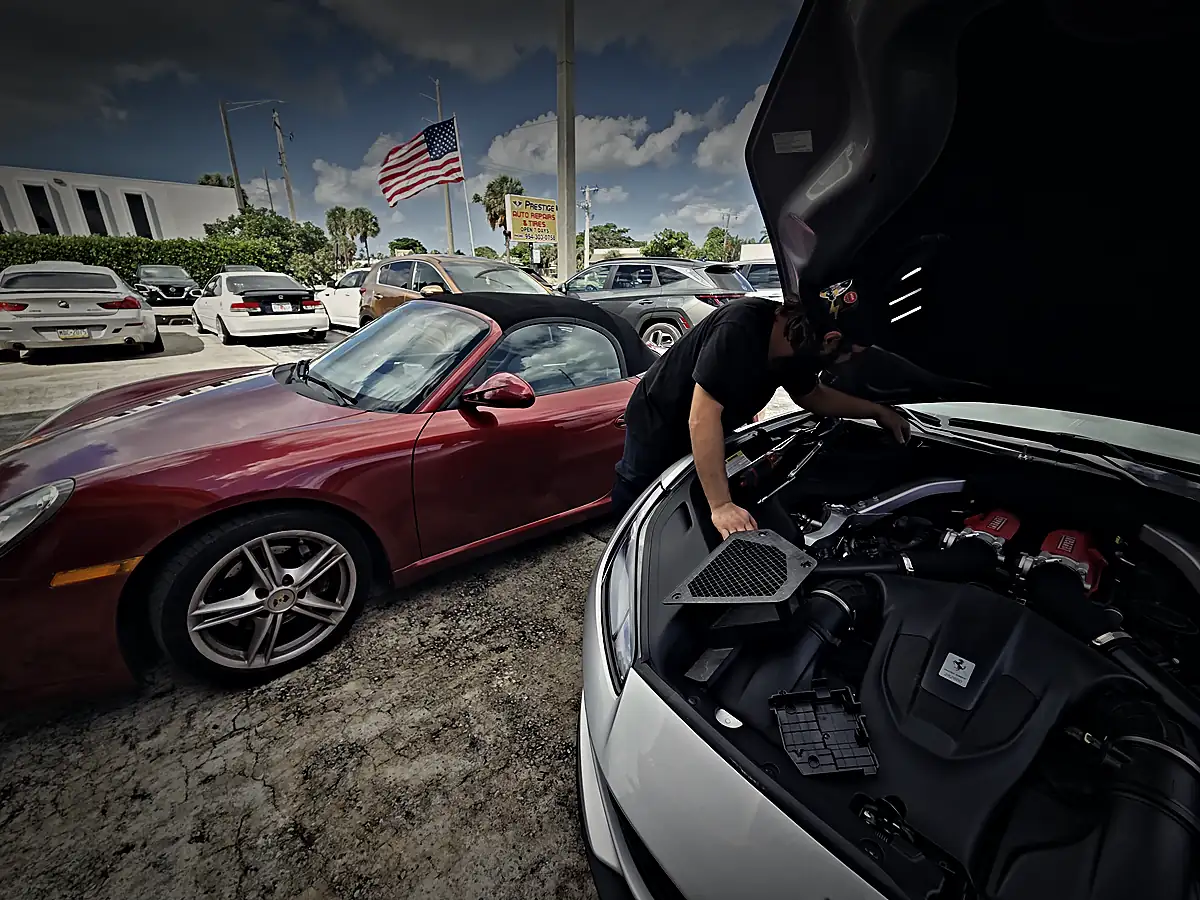
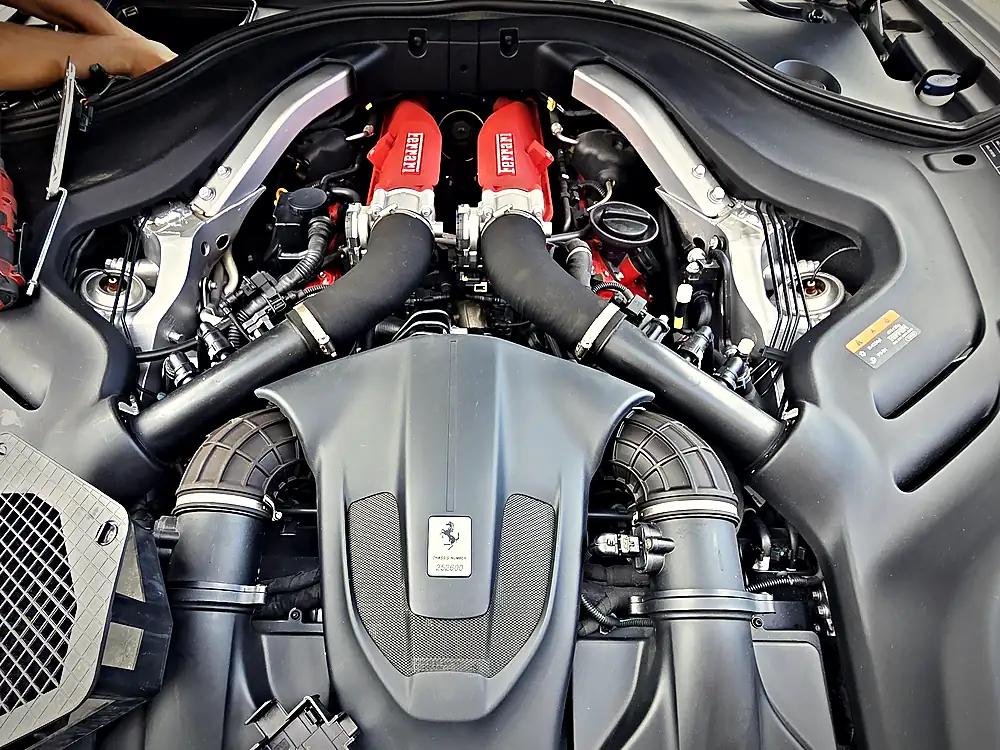
A Maserati check engine light means the engine computer has stored a fault in the engine or emissions system, and the light alone cannot tell you which one. On the Ghibli, Levante, Quattroporte and GranTurismo the usual causes are an evaporative system leak, an ignition coil or spark plug, an oxygen sensor, a cam timing fault, a thermostat or low battery voltage, and reading the stored codes is the first step in telling them apart.
Steady or flashing
Start with how the light behaves.
- Steady light, car drives normally. A fault has been logged. Drive gently and have it scanned soon.
- Flashing light, engine shaking. This is an active misfire. Unburned fuel is reaching the catalytic converters and can overheat them. Ease off the throttle and stop somewhere safe.
- Light with a red temperature or oil pressure warning. Stop the engine. These warnings are more urgent than the check engine light itself.
Common causes on a Maserati
| Symptom you notice | What it usually is | What we check |
|---|---|---|
| Light a day or two after refuelling, car drives normally | Evaporative system leak: fuel cap seal, purge valve or a vapor hose | Cap seal, purge and vent valve operation, smoke test of the vapor lines |
| Steady light, no change in how the car drives, sometimes higher fuel use | Oxygen sensor or catalytic converter efficiency fault | Live sensor readings before and after the converter, fuel trims, exhaust leaks |
| Shake at idle or under load, light may flash | Ignition coil or worn spark plugs | Misfire counters by cylinder, plug condition, coil moved to another cylinder |
| Rattle at cold start on an older V8, cam timing codes | Cam variator or timing fault | Requested against actual cam timing, oil level and condition, startup noise |
| Temperature gauge slow to rise, weak cabin heat on a cool morning | Thermostat stuck open | Coolant temperature against time from a cold start, cooling system for leaks |
| Several warnings together, often after the car has been parked | Low battery voltage | Battery state and health, charging output, ground connections |
| Loss of power with a hiss on a turbo model | Boost leak from a hose or coupling | Smoke test of the intake tract, requested against actual boost |
Evaporative system and fuel cap
The evaporative system keeps fuel vapor from the tank out of the air. The car tests it for leaks on its own, and a very small leak is enough to set a code such as P0456 (small leak) or P0455 (large leak). A cap that was not tightened or has a hardened seal is the simple cause. Purge valves and vapor hoses are the others. When the cap is not the answer, a smoke test finds the leak.
Oxygen sensors and catalytic converters
Each bank of the engine has a sensor ahead of the catalytic converter and one after it. A catalyst efficiency code such as P0420 or P0430 means the rear sensor is seeing too much of what the front sensor sees. The converter may be worn, but an exhaust leak, an ageing sensor or an earlier misfire can produce the same code. Live data separates them, and that matters because a sensor and a converter are very different repairs.
Ignition coils and spark plugs
The 3.0 twin-turbo V6 in most Ghibli, Levante and Quattroporte models, and the 3.8 twin-turbo V8 in GTS and Trofeo versions, work their ignition parts hard under boost. A coil that is failing often misfires under load first, then at idle. Codes P0300 to P0308 identify a random misfire or the cylinder involved. Worn plugs are a frequent reason coils fail, so both are checked together. See spark plug replacement.
Cam variators and timing faults
The naturally aspirated 4.2 and 4.7 V8 in the GranTurismo, GranCabrio and the earlier Quattroporte uses cam variators, which adjust cam timing with oil pressure. A short rattle at cold start, sometimes with cam timing codes, points toward them. Low or old oil makes it worse. The newer turbo engines also adjust cam timing and can log timing codes, but the causes differ by engine, so we read cam data before recommending any timing work.
Thermostat
A thermostat stuck open keeps the engine from reaching full temperature. The computer notices that warm-up took too long and stores P0128. The car feels normal, but an engine that runs cool uses more fuel and wears its oil faster, so the thermostat is worth replacing.
Battery voltage and false warnings
A Maserati that is driven only occasionally is hard on its battery. When voltage dips during starting, modules can log faults that have nothing to do with the parts they name, and several warnings may appear together. We test the battery and charging system before chasing those codes, then clear them and see which return.
Why a brand-capable scan tool matters
A basic code reader talks to the engine computer in the standard OBD-II language that every car supports. It will show a generic code, and for a fuel cap that can be enough. On a Maserati it leaves out a lot:
- Maserati-specific fault codes and their descriptions, which are more precise than the generic ones.
- Other modules. The gearbox, stability control, suspension and body computers keep their own codes, and a fault in one can light a warning in another.
- Live data in detail, such as misfire counts by cylinder, cam timing, fuel trims and boost.
- Tests and adaptations. Running a purge valve or a fan on command, and the relearn steps some repairs need afterward.
Without that, a diagnosis rests on one generic code and a guess. For more on the limits of a basic reader, see what a code scan can and can’t tell you.
How we diagnose it
- Identify the car from its VIN, because a Ghibli V6 and a GranTurismo V8 share very little under the hood.
- Test the battery and charging system.
- Scan every module and save the codes and freeze-frame data before anything is cleared.
- Review live data for the system the codes point to.
- Test by hand: smoke test, coil and plug checks, cooling system checks, as the fault requires.
- Road test when the fault only shows under certain conditions.
- Send photos and a written estimate that names the cause. Nothing is replaced before you approve it.
What to do now
- Tighten the fuel cap until it clicks.
- Note whether the light is steady or flashing and whether the car feels different.
- Leave the codes in place. Clearing them erases the data used to find the fault.
- If the car sits for long periods, mention it. It changes where we look first.
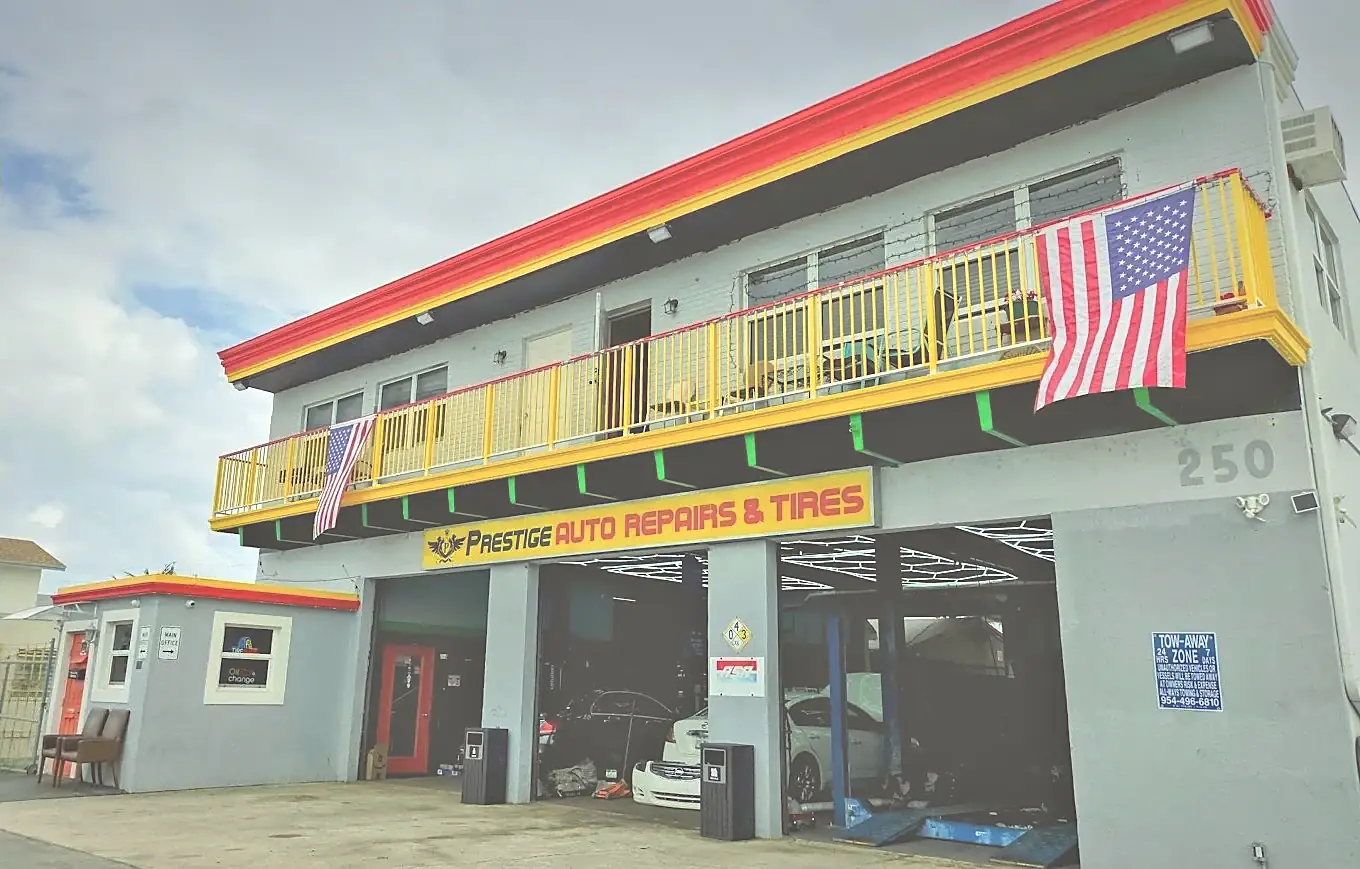
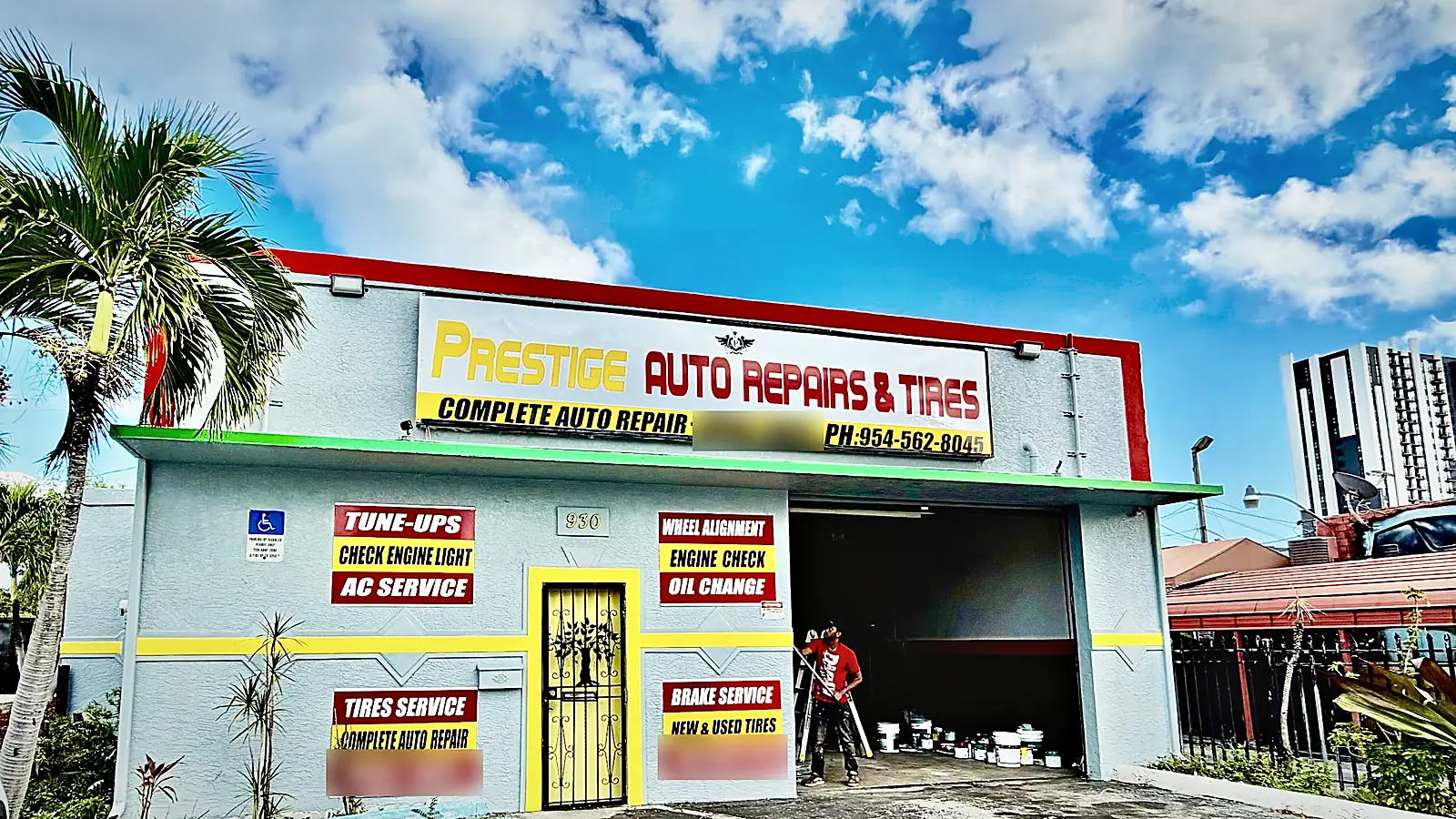
Our Maserati service page lists the models and repairs we handle. You can book a check engine light diagnosis or request an estimate online. Prestige Auto Repairs & Tires has two shops: Oakland Park, 250 NE 44th St, (954) 303-0758, 8 AM to 7 PM all week, and Fort Lauderdale, 930 NE 4th Ave, (954) 562-8045, 8 AM to 7 PM Monday through Saturday and closed on Sunday.
Related repair services
- Check engine light diagnostics in Fort Lauderdale
- Mercedes check engine light in Fort Lauderdale
- Hybrid battery diagnosis in Fort Lauderdale
- Auto electrical repair in Fort Lauderdale
- Car battery replacement in Fort Lauderdale
More car care guides on this topic
- BMW chassis stabilization malfunction: causes and what to do
- BMW drivetrain malfunction: causes and what to do
- BMW VANOS solenoid: symptoms, codes and repair
- EPC light on an Audi or Volkswagen: what it means and what to do
- Mercedes ESP inoperative: see operator's manual — causes and what to do
- Porsche PSM failure warning: causes and what to do