Tesla brake service in Fort Lauderdale is mostly about corrosion, not wear. A Tesla slows itself with its motors, so the pads and rotors can go months doing very little. In Broward’s humidity and salt air, parts that do not move tend to stick. The same weight and torque that spare the brakes are hard on tires, alignment and front suspension joints, and a small low-voltage battery decides whether the car wakes up at all. This page covers those four areas on the Model 3, Model Y, Model S and Model X, and it is plain about which jobs are ours and which are Tesla’s.
Tesla brake service: what goes wrong when brakes are barely used
Regenerative braking turns the motors into generators when you lift off the accelerator. The friction brakes then only finish the stop or handle hard braking. That is why pads last a long time. It is also why these faults show up on cars with plenty of pad left.
| What you notice | Likely cause | What we do |
|---|---|---|
| Scraping or grinding for the first few stops, worse after rain or washing | Surface rust on the rotor faces | Inspect the rotors. Light rust cleans off with use, deep pitting does not |
| Car pulls to one side under braking, or one wheel is hot | Seized slide pin or a piston that does not retract | Release, clean and lubricate the slides, or replace the caliper if the piston or seal has failed |
| Pulsing through the pedal | Uneven rust or pad deposits on the rotor, rust lip at the edge | Measure rotor thickness and runout, then resurface or replace as the numbers allow |
| One pad worn far more than its partner | Caliper not sliding, so one pad does all the work | Service the caliper bracket and hardware, replace pads as a set per axle |
| Soft or long pedal | Old fluid with moisture in it, or air in the system | Test the fluid, then flush and bleed with the specified fluid |
| Squeal at low speed | Glazed pads, dry hardware, corrosion under the pad clips | Clean the bracket lands, fit new hardware where needed |
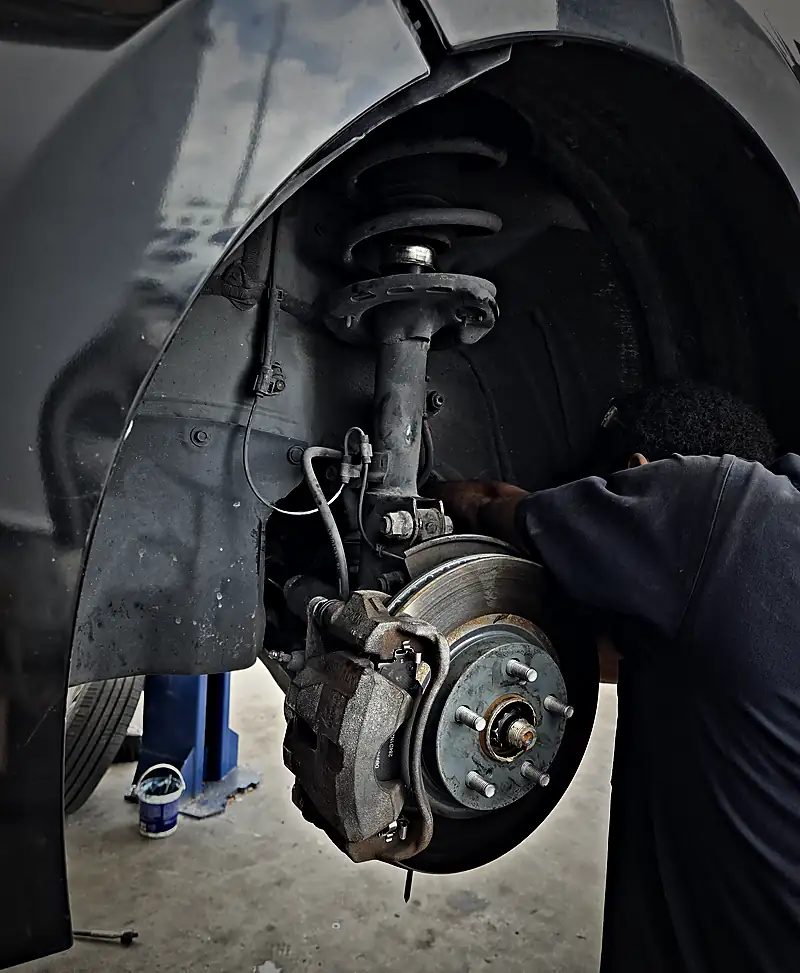
A caliper service on a Tesla means taking the pads out, cleaning the bracket where the pads sit, checking that each slide pin moves by hand, inspecting the dust boots and lubricating with brake-rated grease. Rear calipers on the Model 3 and Model Y carry the electric parking brake, so the parking brake has to be put into its service position from the touchscreen before the pistons can be pushed back. Forcing them damages the actuator.
Brake fluid. Brake fluid absorbs moisture over time, and humid air speeds that up. Tesla lists a brake fluid health check every four years in current Model 3 and Model Y owner’s manuals, with replacement if the test calls for it. Intervals have changed over the years and differ by model, so we go by the manual for your car and by the test result. We test the fluid and show you the reading.
Rotors. A rotor that is only rusty on the surface usually cleans up. One with deep pitting, a heavy rust lip or thickness below the minimum stamped on it gets replaced. We measure before we recommend either.
One habit helps between visits: a few firm stops from speed now and then wipe the rotor faces clean. Tesla’s manual suggests using the brake pedal regularly for this reason. Our general brake repair in Fort Lauderdale page covers brake work on other makes.
Tesla tires: why they wear fast and what to buy
A Tesla is heavy for its size and puts full torque to the road from a standstill. Both shorten tire life. Three things are specific to these cars.
- Load rating. Most Teslas need extra-load (XL) tires. A tire in the right size but the wrong load rating is not correct for the car. The placard in the driver’s door jamb is the reference.
- Tesla-marked tires. Original tires often carry a T0, T1 or T2 mark on the sidewall, which means the tire maker built that version to Tesla’s specification. A replacement without the mark can still be suitable if the size, load and speed ratings match. We explain the trade-offs in noise and range before you choose.
- Acoustic foam. Many original Tesla tires have a foam liner glued inside the tread to cut cabin noise. They mount and balance like any tire, but the foam must stay intact, and a puncture repair needs the foam trimmed back at the injury. A replacement tire without foam fits and works. It is usually a little louder.
Rotation. Tesla recommends rotating every 6,250 miles, or sooner if tread depth differs by 2/32 inch or more between tires. On cars with the same size at all four corners we rotate front to rear. Cars with wider rear tires, such as many Model S, Model X and Performance versions, cannot swap front to rear, so alignment matters even more on them.
Lifting the car. The battery pack is the floor of the car. A Tesla has four designated lift points, and a lift arm or jack anywhere else can damage the pack. We use lift pads at those points, and on air suspension cars we put the suspension into Jack Mode first.
Tire pressure sensors. Newer Teslas use Bluetooth tire pressure sensors and older ones use radio-frequency sensors. They are not interchangeable, so we match the sensor to the car when a wheel or sensor is replaced. After a tire change the car relearns the sensors as it is driven.
Tire sizes, brands and mounting for all makes are on our tires and wheel alignment page.
Tesla wheel alignment
A four-wheel alignment sets toe, and where the car allows it camber and caster, to Tesla’s specification. We check the alignment when tires are replaced, when the steering wheel sits off-center, when the car pulls, and after a pothole or curb strike.
- Toe does the damage. A small toe error scrubs the tire sideways with every mile. On a heavy car with wide tires that removes the inner shoulder quickly.
- Not every angle is adjustable. On several Tesla models some angles have no factory adjustment at a given corner. If one of those is out of range, the cause is usually a bent or worn part, and we look for it instead of adjusting around it. Adjustable aftermarket arms exist for lowered cars, and we tell you when that is the only way to bring an angle back.
- Ride height matters on air suspension. On the Model S and Model X, camber changes with suspension height. We align at the height the procedure calls for, and we ask how you normally drive the car.
- Suspension first, alignment second. An alignment set on worn control arm bushings or ball joints will not hold. We check the joints before the car goes on the alignment rack.
You get a before and after printout with every angle and its allowed range.
Suspension noises and front control arms
Front suspension joints carry a lot of weight on these cars, and two patterns come up often.
Model 3 and Model Y: front upper control arm. A creak or squeak from the front at low speed, over speed bumps or while turning the steering wheel, often louder after rain, commonly traces to the ball joint in the front upper control arm. Water gets past the seal and the joint runs dry. The repair is a new arm on the affected side, or both sides if both joints are worn, followed by an alignment check.
Model S and Model X: front lower links. These cars use two lower links on each side at the front. Their bushings and ball joints wear and produce a clunk over bumps or when braking, a loose feel in the steering, or uneven front tire wear. We check each link for play with the car loaded and unloaded.
Other sources we rule out before naming a part:
- Sway bar links and bushings, which knock over small bumps
- Strut top mounts and, on air suspension cars, the air struts and their mounts
- A shudder under hard acceleration on the Model S or Model X, which can come from the front half-shafts and is a different fault from a control arm
- Loose underbody panels, wheel liners and brake dust shields, which rattle and get mistaken for suspension
How we test steering and suspension on any car is on our steering and suspension repair page. Noise diagnosis starts with a road test with you in the car where possible, so we hear the same sound you do.
The 12V or low-voltage battery
Every Tesla has a small low-voltage battery in addition to the main pack. It runs the computers, locks, lights and screens, and it powers the contactors that connect the main pack. The main pack keeps it charged through a DC-DC converter.
Lead-acid on older cars. Earlier Model S, Model X, Model 3 and Model Y cars use a 12V lead-acid battery. Heat shortens its life, as it does on any car here. It is a wear item, and replacing it is routine work for us. We test the old battery, follow Tesla’s power-down steps before disconnecting it, fit the correct type and confirm the car charges it afterward.
Lithium on newer cars. Newer cars use a small lithium-ion low-voltage battery. It is designed to last far longer than a lead-acid one, and it is a different part with different handling. If a newer car reports a low-voltage fault, we test the system and tell you what we find. Where the part is still covered by Tesla’s warranty, that repair belongs with Tesla.
The warning. The car monitors this battery and shows a message on the touchscreen when it is weak, asking you to replace it or schedule service. Do not wait for a second warning.
What happens when it fails. The car may not wake when you walk up. Doors may not open electrically, the touchscreen stays dark, the charge port may not release the cable, and the car will not go into Drive. The front doors have a mechanical release inside. Rear door releases differ by model and year, so it is worth finding yours in the owner’s manual before you need it. On most models the low-voltage battery sits under the hood, and the manual describes how to open the hood with an external 12V supply if the car has no power.
What does not fix it. A full main battery does not help if the low-voltage battery cannot run the computers. Tesla also advises against using the car to jump-start another vehicle.
Battery testing for all makes is covered on our battery replacement page.
What an independent shop can and cannot do on a Tesla
Prestige Auto Repairs & Tires is an independent shop. We are not part of Tesla and we do not claim Tesla approval or certification.
What we do:
- Brake inspection, caliper service, pads, rotors and brake fluid
- Tires, balancing, rotation, puncture repair and tire pressure sensors
- Four-wheel alignment with a printout
- Control arms, links, bushings, sway bar links and other steering and suspension parts
- 12V lead-acid battery testing and replacement, and low-voltage system testing
- Cabin air filters and wiper blades
- Pre-purchase and lease-return inspections with photos
What stays with Tesla:
- High-voltage battery pack repair or replacement.
- Drive unit repair or replacement. That covers the motor, gearbox and inverter assembly.
- Warranty work. Tesla’s vehicle warranty and its separate battery and drive unit warranty are honored by Tesla. The battery and drive unit warranty runs eight years, with a mileage limit that depends on the model.
- Recalls and Tesla service campaigns. These are performed by Tesla.
- Software and firmware. Updates come from Tesla.
Some faults also need Tesla’s own diagnostic software, or a part that has to be programmed to the car. When a job needs that and we cannot complete it properly, we say so before we start, not after.
How South Florida conditions affect these parts
- Salt air. Cars parked near the beach or the Intracoastal build rotor and caliper rust faster than the mileage suggests.
- Short trips. A commute of a few miles on regenerative braking may never bring the brakes up to a temperature that dries them.
- Rain and standing water. Daily summer storms put water on rotors and into suspension joints.
- Heat. Hot pavement softens tread, and under-hood heat ages a lead-acid 12V battery.
- Rough pavement. Expansion joints and potholes move alignment settings and wear front suspension joints.
Our guide to EV and hybrid care in Florida heat covers the seasonal checks an owner can do.
What a visit looks like
- Tell us what you notice, and whether any message is on the screen.
- Road test, when the concern is a noise, a pull or a vibration.
- Wheels off. We measure pads and rotors, check that each caliper slides, measure tread at three points across every tire and check each suspension joint for play.
- Low-voltage battery test and a look at any stored alerts the car shows.
- Photos and a written estimate on your phone, with safety items listed first.
- Work begins after you approve it. Repairs carry our 2-year / 24,000-mile warranty.
Tesla brakes, tires and alignment at both shops
This work is done at both locations. For other Tesla, Rivian and Lucid repairs, see Tesla repair in Fort Lauderdale. EVs and hybrids from other makers are covered on our EV and hybrid service page.
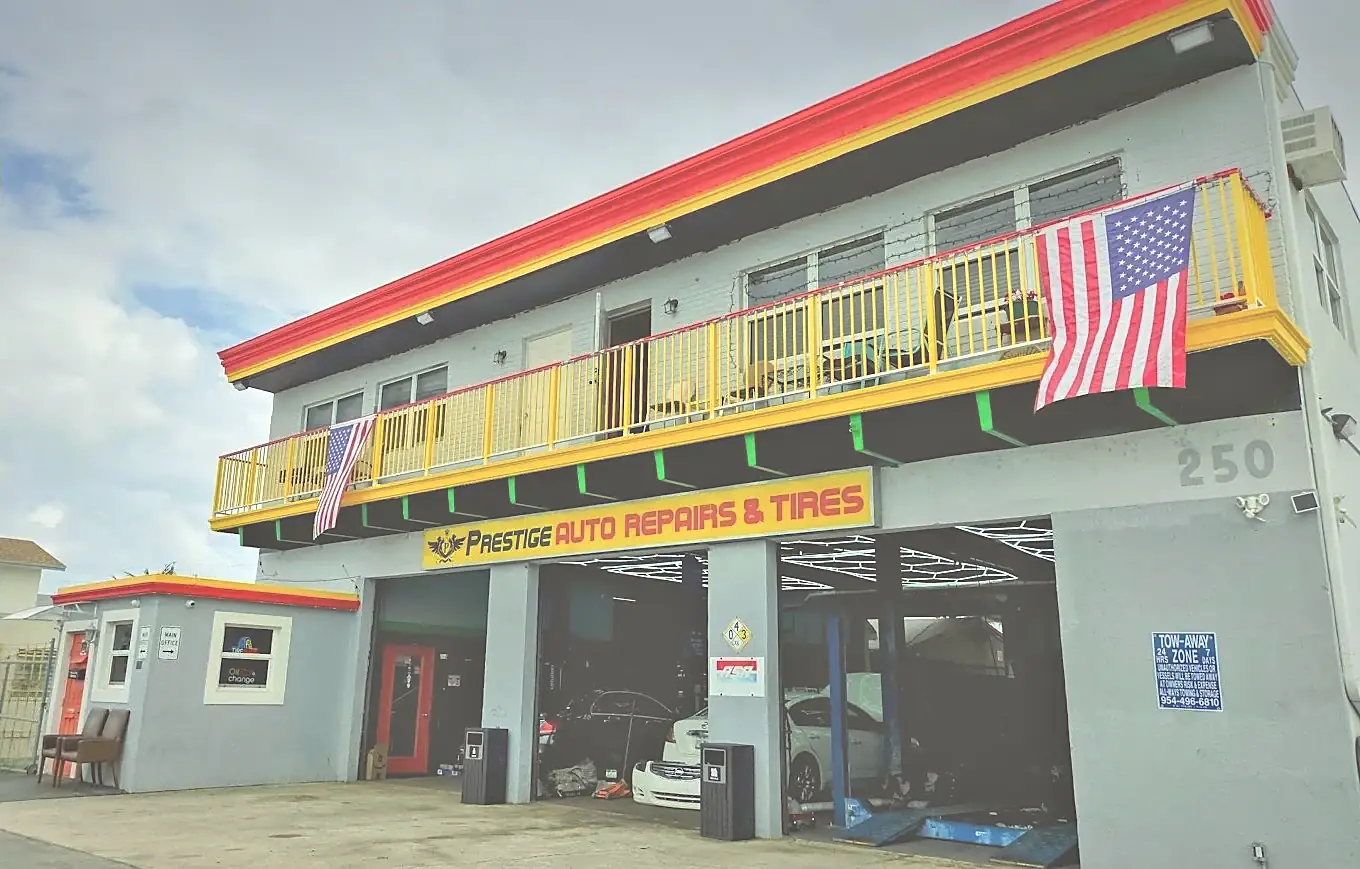
- Oakland Park: 250 NE 44th St, open 7 days, 8 AM to 7 PM. Call (954) 303-0758.
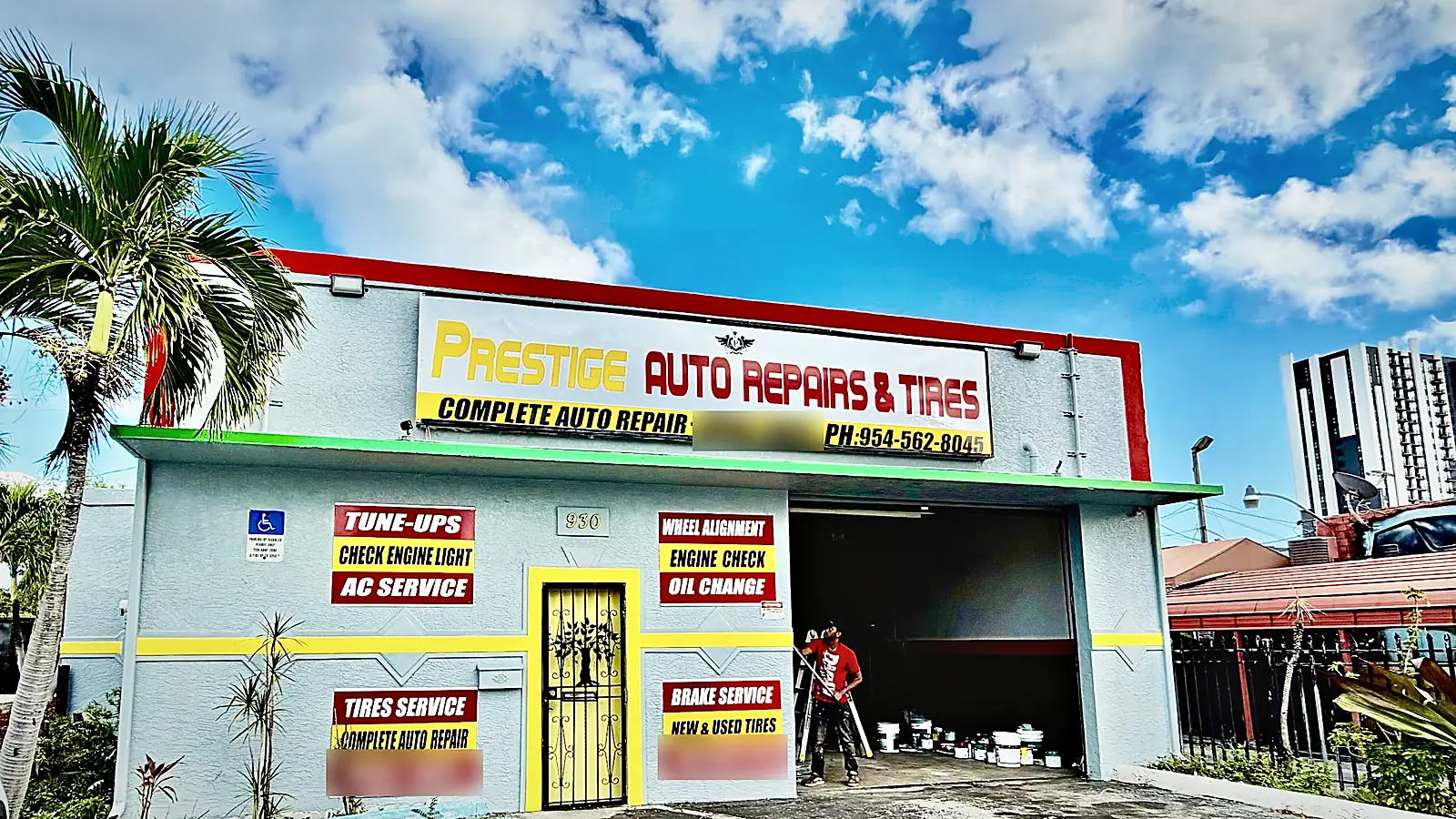
- Fort Lauderdale: 930 NE 4th Ave, open Monday to Saturday, 8 AM to 7 PM, closed Sunday. Call (954) 562-8045.
Walk in at either shop, or request an estimate and tell us the model, year and what you notice. We speak English and Spanish at both shops.
Part of our electric car guide: Tesla repair in Fort Lauderdale