The Mercedes-Benz problems Prestige Auto Repairs & Tires sees most at its Oakland Park and Fort Lauderdale shops follow the engine code: camshaft adjuster magnets and timing on the M274 and M264 four-cylinders, timing chains and oil cooler seals on the M276 V6, heat damage around the turbos on the M278, M177 and M176 V8s, oil cooler seals on the OM642 diesel, and brittle plastic cooling parts on all of them. This guide lists what fails on each engine, what it feels like from the driver’s seat, and how we confirm it with XENTRY before anything is taken apart.
Why the engine code matters
Two Mercedes with the same badge can have very different engines. A 2016 C 300 and a 2021 C 300 share a name but not an engine, and the faults they develop are not the same. The engine code is on the data card in the glovebox or trunk, and XENTRY reads it in seconds. Knowing it narrows the search before the hood is open.
The quick table
| Engine | Found in | What we see most |
|---|---|---|
| M274 (2.0 turbo four) | C 300, E 300, GLC 300, SLC 300 (about 2015–2020) | Camshaft magnet oil leaks, cold-start chain or adjuster rattle, valve cover and oil filter housing leaks |
| M264 (2.0 turbo four, often 48-volt) | C 300, E 350, GLC 300, GLE 350 (about 2019 on) | Coolant leaks, camshaft magnets, 48-volt belt starter-generator warnings |
| M276 (3.0 and 3.5 V6) | C 400, E 350, E 400, ML 350, GLE 400, S 450 | Timing chain stretch on early engines, camshaft adjusters, oil filter housing and oil cooler seals |
| M278 (4.6 twin-turbo V8) | S 550, E 550, CL 550, GL 550, ML 550 | Timing chains and guides, camshaft adjusters, coolant leaks, turbo oil and coolant lines |
| M177 / M176 (4.0 twin-turbo V8) | AMG C 63, E 63, G 63, AMG GT 63 4-door; S 560, G 550, GLE 580 | Heat around the hot-V turbos, coolant and oil lines, spark plugs and coils |
| OM642 (3.0 V6 diesel) | ML 350, GL 350 and E 350 BlueTEC, Sprinter | Oil cooler seal leaks, intake swirl flaps, NOx sensors and AdBlue (DEF) faults |
If your engine is not on the list, we service it too. The table shows where we look first, not the limit of what we fix.
M274 and M264 four-cylinders: camshaft magnets and timing
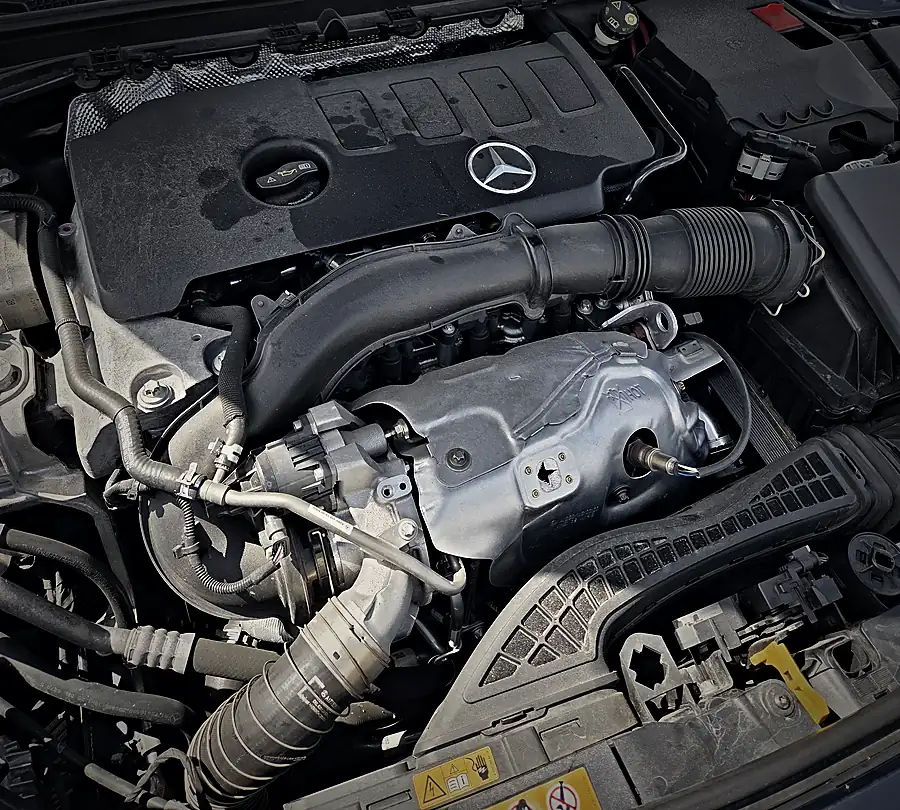
The camshaft adjuster magnets, often called camshaft solenoids, sit on the front of the engine and control the variable valve timing. Their internal seals harden with heat, and engine oil then seeps through the solenoid and into its electrical connector. Left alone, oil wicks along the wiring harness toward other connectors and, in the worst cases, a control unit. We replace the magnets, deal with the oily connector and check the harness. These engines can also rattle for a few seconds at cold start from a camshaft adjuster or a stretched timing chain. We check cam and crank correlation with XENTRY before recommending chain work, because the fix differs. Valve cover and oil filter housing leaks are the other usual visits. More on our oil leak repair page.
On the M264, the 48-volt belt starter-generator adds a second battery and its own warnings. A “stop vehicle, leave engine running” message or a 48-volt fault often comes down to the auxiliary battery or its wiring, which we test before anything is replaced.
M276 V6 and the older M272
The M276 V6 arrived around 2011 and replaced the M272. Some early M276 engines stretched their timing chains, which shows as a cold-start rattle and camshaft position codes. The famous balance shaft sprocket wear belongs to the older M272 V6 of about 2005–2008. If you own one, we can tell which problem you have from XENTRY camshaft data before anything is taken apart. On both engines the oil filter housing and the oil cooler seals under it harden and leak, and oil can run onto the belt and exhaust.
M278, M177 and M176 V8s
The M278 4.6-liter twin-turbo V8 in the S 550, GL 550 and similar models is a strong engine that runs hot. We see timing chain and guide wear at higher mileage, camshaft adjuster faults, and coolant leaks from hoses and pipes in the valley. The 4.0-liter M177 (AMG) and M176 (non-AMG) place their turbos inside the V of the engine. That heat ages nearby rubber and plastic, so coolant lines, turbo oil feeds and ignition coils get a close look on every inspection. On an AMG that is driven hard, spark plugs and coils age faster than the service book expects, and a misfire under boost is often the first sign.
OM642 V6 diesel: oil cooler seals
The OM642 3.0 V6 diesel in BlueTEC models and Sprinter vans has an oil cooler that sits in the valley between the cylinder heads. Its seals harden and leak, and oil pools in the V before it runs down the back of the engine, where it can look like a rear main seal leak. Replacing the seals means removing the intake and parts of the turbo system, so we confirm the source with a clean-and-check before quoting. The same engine’s intake swirl flaps, NOx sensors and AdBlue system produce most of its check engine lights; our Mercedes check engine light guide covers those codes.
Coolant leaks, thermostats and water pumps
Mercedes cooling systems use plastic pipes, expansion tanks and thermostat housings that turn brittle after years of heat cycles. Many newer engines use an electronically controlled thermostat, and some use an electric water pump. A sweet coolant smell, a low-coolant message or a temperature gauge that climbs on I-95 traffic are reasons to check it soon. We pressure-test the system to find the leak before replacing parts. See coolant leak repair, and for the dash message itself, Mercedes check coolant level warning: causes and what to do.
Beyond the engine: the other faults we see weekly
- 7G-Tronic conductor plate and valve body. Harsh or delayed shifts, a gearbox stuck in one gear, or a “transmission visit workshop” message on a 722.9 unit usually trace to the conductor plate’s speed sensors or the valve body. Details on our Mercedes transmission repair page.
- SAM modules and water. The signal acquisition modules sit low in the body, and a blocked drain or a leaking seal lets water reach them. Random electrical faults after a heavy rain, and lights that behave strangely, point there first.
- AIRMATIC sag. A car that sits low overnight on one corner has a leaking air spring or valve block; the compressor fails later if it is left. See AIRMATIC repair.
- Auxiliary battery messages. The small auxiliary battery behind the glovebox or under the seat ages faster in heat and triggers its own message long before the car fails to start.
How we confirm a fault before quoting
Every Mercedes diagnosis at our shops starts with a full XENTRY scan, saved before anything is cleared, then a look at the actual part: camshaft correlation values for timing complaints, a UV dye and pressure test for coolant, a clean-and-check for oil leaks in the valley, live data for the conductor plate. You get photos of what we found and a written estimate that separates what has failed from what is about to, and repairs carry a 2-year / 24,000-mile warranty. The Mercedes-Benz repair in Fort Lauderdale page lists everything we handle on these cars; walk in at either shop or request an estimate with a photo of the dash.
Related repair services
- Mercedes-Benz repair in Fort Lauderdale
- German auto repair in Fort Lauderdale
- BMW repair in Fort Lauderdale
- Audi repair in Fort Lauderdale
- Porsche repair in Fort Lauderdale
- Volkswagen repair in Fort Lauderdale
- MINI Cooper repair in Fort Lauderdale