A used Porsche hides its expensive problems well. A 997 with scored cylinder bores idles smoothly for a ten-minute test drive, a PDK with worn clutches shifts cleanly until it is hot, and a 996 that was over-revved last month looks exactly like one that was not. The car itself keeps the evidence in its control units, its oil filter and its paint, and a pre-purchase inspection is how you read it before the money moves.
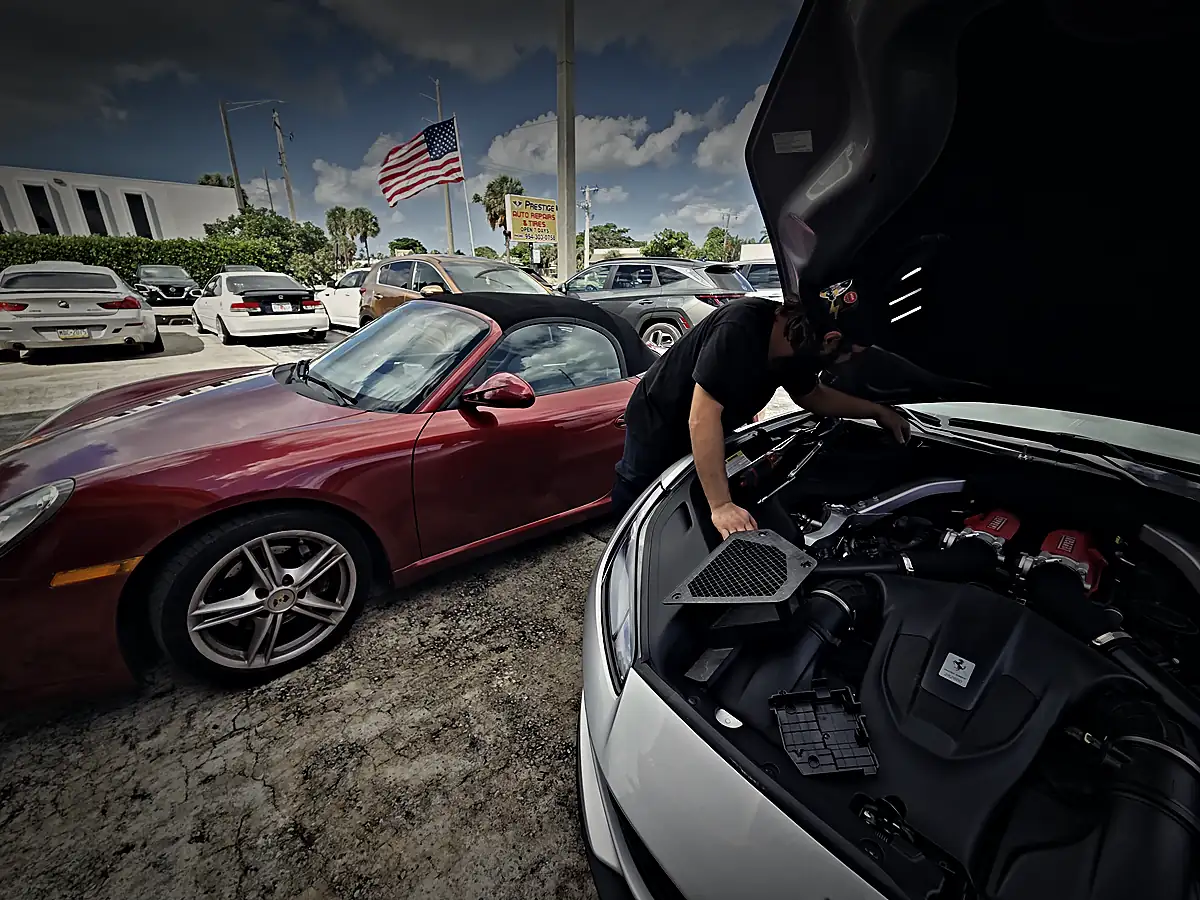
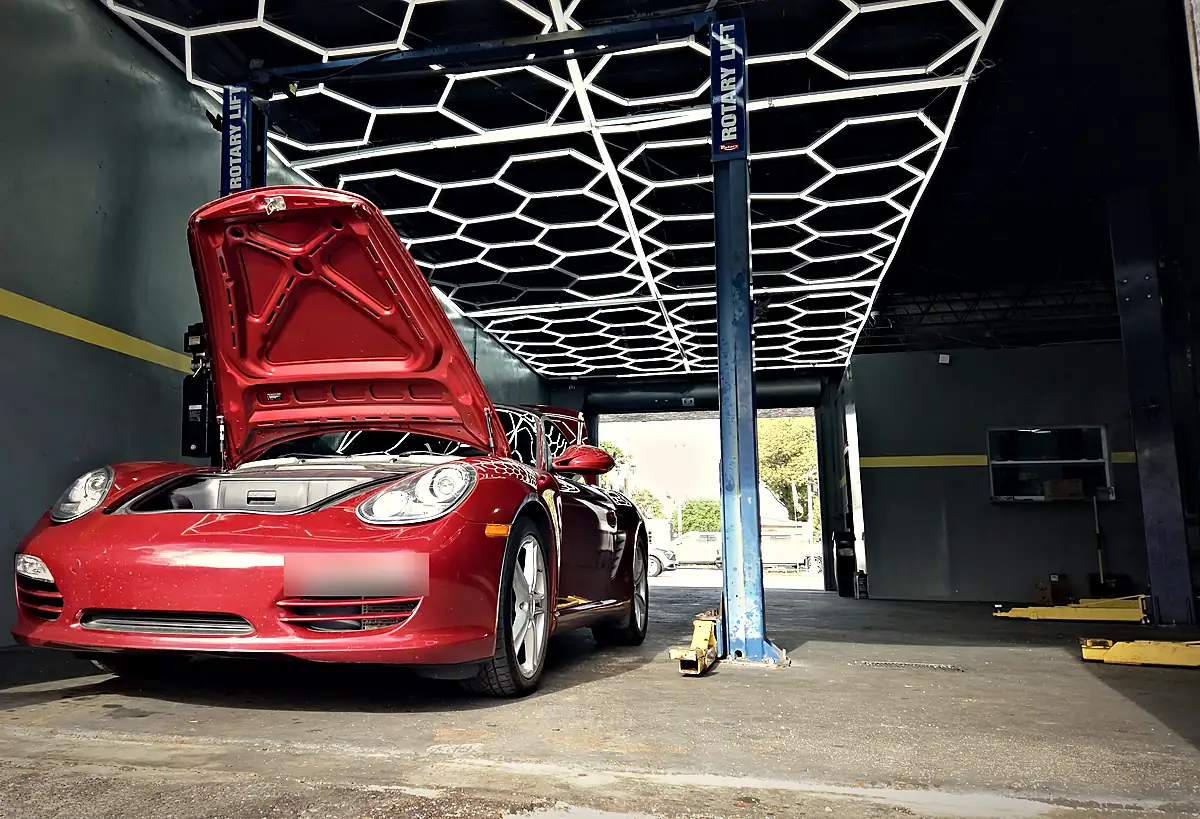
Prestige Auto Repairs & Tires inspects used Porsches for buyers at the Fort Lauderdale and Oakland Park shops, with PIWIS-level software, a lift, a borescope and a paint-depth gauge. This guide lists what we check, model by model, and which findings should change the price or stop the purchase. Our general pre-purchase inspection page covers the standard inspection every car gets; the Porsche steps below are added on top of it.
The three reports a test drive cannot give you
Over-rev report. The engine control unit logs every trip past the redline, sorted into ranges by how far past the limiter the engine went, each with the engine hours at the time. Ranges 1 and 2 are the limiter doing its job under hard driving. Range 3 and above on a manual car mean a downshift into the wrong gear, which can bend valves or hurt rod bearings without any symptom for years. We print the report and compare the hours to the current engine hours, so you know whether the events are ancient history or last weekend.
PDK and clutch data. On a 2009-or-later car with the dual-clutch gearbox, the control unit stores clutch wear for both clutches, adaptation values, operating temperatures and faults. On a manual car with the Mezger or 9A1 engine, clutch life has to be judged by feel and pedal travel, so we road test it hot.
Fault memory with freeze frames. Sellers clear codes. PIWIS-level tools show which modules were cleared recently and still hold the freeze-frame data from the last stored events, which is often the most honest history the car has.
Engine checks by generation
| Car | Engine | What we look for |
|---|---|---|
| 1997–2004 Boxster (986), 1999–2005 911 (996) | M96 | IMS bearing update proof, metal in the oil filter, rear main seal and cam cover leaks, air-oil separator, cracked plastic coolant tank |
| 2005–2008 Boxster and Cayman (987.1), 2005–2008 911 (997.1) | M97 | Same IMS and leak checks, plus bore scoring on the 3.8 Carrera S: left-bank tick, left tailpipe soot, borescope |
| 2009-on Boxster, Cayman, 911 (987.2, 981, 997.2, 991, 718, 992) | 9A1 and successors | Cam deviation values, water pump and thermostat seepage, cam cover and oil cooler leaks, PDK data |
| 996 and 997 Turbo, GT2, GT3 | Mezger | Glued coolant pipe joints (we check whether they were pinned or welded), turbo oil and coolant lines, over-rev report with extra weight |
| Cayenne V8 (2003–2010 especially) | M48 | Plastic coolant pipes in the engine valley, driveshaft center bearing, transfer case, air suspension leaks |
| Cayenne and Macan V6 | Various | Turbo coolant lines, transfer case service, plastic thermostat and water pump housings |
| Macan 2.0T | EA888 family | Timing chain tensioner noise on a cold start, PCV valve, water pump housing seepage |
| Panamera | V6 and V8 | Coolant pipe and thermostat housing leaks, PDK data, air suspension and PDCC where fitted |
| Taycan | Electric | High-voltage battery state of health through the scan, charging log, 12V battery, brake corrosion from regenerative braking |
The pattern across the table: Porsche engines fail at plastic cooling parts and seals long before they fail at pistons, and the few that do fail at pistons announce it through the oil filter and the tailpipe first.
IMS and bore scoring, in plain terms
The intermediate shaft bearing in the M96 and M97 engines drives the camshaft chains and runs on a sealed bearing that can wear and, rarely, let the cam timing slip. The single-row bearing used from about 2001 to 2005 has the poorest record. On an affected car we want proof of an update kit, or we cut the oil filter open and photograph what is in it. Our PDK and IMS bearing service page has the table of which engines carry it.
Bore scoring is scratching of the cylinder walls that causes a ticking at idle, oil use and soot on one tailpipe, most often on the 3.8-liter 997.1 Carrera S. It is a rebuild, not a repair, so it is the one finding that should stop a purchase outright. A borescope through the spark plug holes confirms or clears it.
Cooling system: where the money usually goes
Porsche cooling systems use plastic where other makers use metal, and South Florida heat shortens the life of every piece of it. On the lift we check the coolant expansion tank for the white crust that marks a seam leak, the water pump weep hole, the thermostat housing, and the radiators and condensers in the nose, which collect debris and corrode behind the bumper. On a first-generation Cayenne V8 we look for the valley coolant pipes, because the plastic originals crack and the metal replacements are an engine-out-of-the-way job. On a Mezger-engined Turbo or GT3 we look at whether the glued coolant pipe joints were pinned.
Suspension, brakes, wheels and tires
- PASM dampers are checked for leaks and for a fault in the scan; a car with one dead damper rides acceptably and costs two to put right, since they are replaced in pairs.
- Control arm bushings and coffin arms on 996, 997 and 987 cars wear and show as a wander at highway speed and inner-edge tire wear.
- Brakes are measured: pad thickness, rotor thickness against the minimum, and on cars with carbon-ceramic PCCB discs the wear measured the way Porsche specifies, since those discs are replaced by weight loss, not by look.
- Wheels are inspected for curb damage, bends and repairs, and the tire date codes are read, because a low-mileage Porsche often sits on original tires that are old enough to crack. Our tire date code decoder shows how.
- Air suspension on Cayenne, Panamera and Macan cars is checked for ride-height faults, compressor run time and leaks at the struts.
Body, paint and structure
A paint-depth gauge reads every panel. Factory paint is consistent; a respray on the front bumper is normal road-rash repair, while a repainted door or quarter panel with filler underneath is a collision the seller did not mention. We check panel gaps, the underbody and the front lift system where fitted, the convertible top and its drains on Boxster and 911 Cabriolet cars, and the sunroof drains on coupes, because a blocked drain puts water into the footwell and the control units under the seats. On any South Florida car we look for silt and corrosion that mark a flood history; our used luxury car buying guide covers those signs in detail.
What should change the price, and what should stop the deal
| Finding | What it means for the deal |
|---|---|
| Range 1 and 2 over-revs only | Normal use; no adjustment |
| Range 3+ over-revs on a manual, recent hours | Negotiate hard or walk; ask for a leak-down test |
| No IMS update proof on an M96 or M97 car | Price in the update, usually done with a clutch |
| Bore scoring confirmed by borescope | Walk away unless the price assumes a rebuild |
| PDK clutch wear high or faults stored | Price in a PDK service and possible clutch pack |
| Coolant tank, water pump or pipe seepage | Normal wear; price in the repair |
| One PASM damper leaking | Price in a pair |
| Paint depth shows filler on a structural panel | Walk away or demand the collision records |
| Original tires past six years old | Price in a set |
| Flood signs: silt, corroded connectors, musty carpet | Walk away |
You get the scan printouts, the photos and a written estimate for everything found, and we say plainly which lines are routine wear on a car of that age and which are reasons to keep looking.
Porsche pre-purchase inspection in Fort Lauderdale and Oakland Park
Prestige Auto Repairs & Tires is an independent shop and is not affiliated with Porsche. Sellers can bring the car to either shop, or we can arrange pickup through our concierge service for a car at a dealer lot in Broward. Fort Lauderdale, 930 NE 4th Ave, (954) 562-8045, is open Monday to Saturday, 8 AM to 7 PM. Oakland Park, 250 NE 44th St, (954) 303-0758, is open 7 days, 8 AM to 7 PM. If you buy the car, the Porsche repair and Porsche maintenance schedule pages cover what comes next. Request an estimate with the year, model and the listing link, and we will tell you which of the checks above apply to that car.
Related repair services
- Pre-purchase inspection in Fort Lauderdale
- Scheduled car maintenance in Fort Lauderdale
- Oil change in Fort Lauderdale
More car care guides on this topic
- Audi oil level sensor warning: what it means and what to do
- Oil Change Intervals for Synthetic Oil: What Your Car Actually Needs
- European Car Maintenance Schedules Decoded: BMW, Mercedes-Benz, Audi and Porsche
- Buying a Used Luxury Car in South Florida: What a Pre-Purchase Inspection Catches
- Salt Air and Your Car: What Corrodes First When You Live Near the Beach
- Oil Change in Fort Lauderdale: Why the Oil Spec Matters on European Cars